


By ORONST ORBITAL — Your Premium Marketplace for Star Citizen Assets
1. Introduction: The Drake Revolution
The Gap in the Heavy Cargo Market
For years, the heavy cargo segment of the Star Citizen ‘verse has been dominated by two extremes. On one end sits the Crusader Hercules C2 — refined, polished, and broadly reliable — but lacking the raw industrial grit that many operators crave. On the other floats the MISC Hull-C, the reigning champion of pure volume, yet fundamentally compromised by its external cargo spindles that leave every SCU exposed to the vacuum and to wandering eyes with itchy trigger fingers.
Between these two poles yawned a gap wide enough to fly a Reclaimer through: a ship that could haul serious tonnage without sacrificing protection. A ship that didn’t demand the financial infrastructure of a mega-corporation or the militarized logistics train of a UEE battle group. A ship built for the independent operator who understands that deep-space traversal is not a luxury cruise — it’s a calculated gamble where the house usually wins.
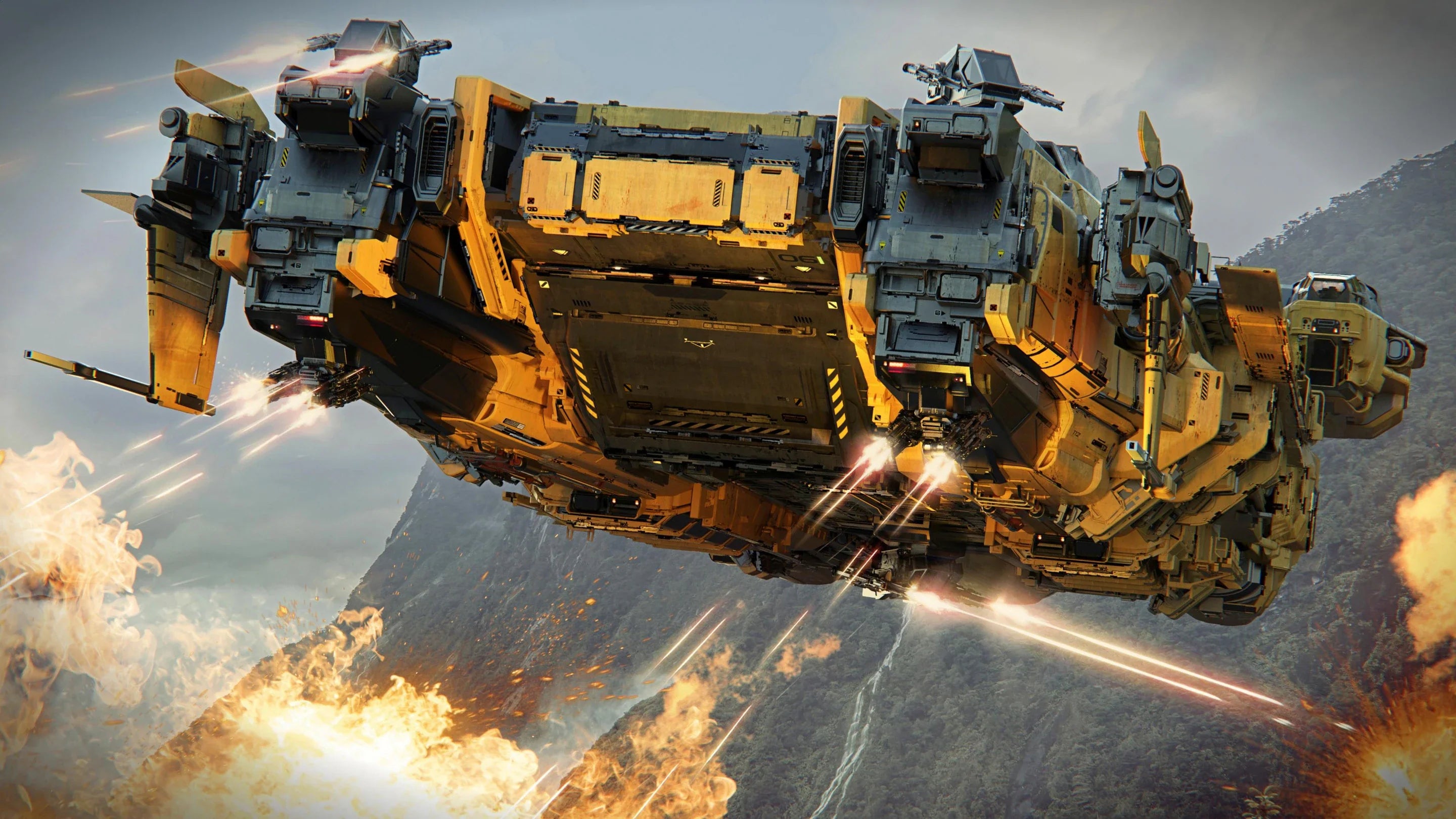
That gap now has a name: the Drake Ironclad.
Conceived at the intersection of Drake Interplanetary‘s unapologetic industrial heritage and the community’s clamoring for a genuinely armored cargo platform, the Ironclad represents something rare in modern aerospace — a ship that refuses to apologize for what it is. Unveiled during Invictus Launch Week 2954 as a concept that sent ripples through every hauling org in the ‘verse, the Ironclad has since progressed steadily through the production pipeline. Its 2026 release window places it among the most realistic and immediately impactful additions to player fleets, with development tracking from whitebox through LOD zero alongside other anticipated heavyweights like the Kraken.
Why the Ironclad Is the “Working Man‘s Kraken”
Label a ship the “Working Man’s Kraken” and you‘ve said something specific. The Drake Kraken is, by any measure, a capital-class carrier — a fleet-level asset that demands an org to crew, fund, and defend it. The Ironclad strips that philosophy down to its load-bearing skeleton. Six crew members. One cargo bay. One mission: move valuable goods through dangerous space and survive the attempt.
Where the Kraken is the headquarters, the Ironclad is the supply line. Where the Kraken commands a fleet action, the Ironclad makes sure there are torpedoes to load and rations to eat. It is the logistical backbone dressed in armor plate, and for the independent pilot who can’t field a thirty-person crew but still needs to operate in hostile territory, it is the closest thing to a force multiplier that Drake has ever produced.
This definitive guide is ORONST ORBITAL‘s comprehensive resource for everything Ironclad. Whether you’re evaluating a purchase, planning org-level logistics, or simply indulging your fascination with Drake‘s most formidable freighter to date, the analysis that follows is built to answer every question worth asking.
Keywords: Drake Ironclad guide, Star Citizen heavy cargo, Drake Interplanetary ships, armored freighter, SCU capacity, cargo gameplay
2. Design Philosophy: Form Follows Function
The Drake Aesthetic: Industrial, Raw, and Uncompromising
There is a particular smell to a Drake ship — a cocktail of hydraulic fluid, scorched conduit shielding, and the metallic tang of a hull that has never been polished. It is not the sterile, climate-controlled environment of an Origin vessel, nor the military precision of an Aegis warship. It is the smell of a machine built by people who assume you already know how things work and don’t need a user manual printed in six languages.
Drake Interplanetary‘s design language is, at its core, an argument. The argument goes: a spacecraft is a tool. Tools do not need to be beautiful. Tools need to work, every time, in conditions that would make an insurance adjuster weep. This philosophy radiates from every weld line and exposed conduit aboard the Ironclad. The ship wears its structural skeleton on the outside because routing systems internally would make them harder to access for field repairs. The plating is thick not because someone in marketing thought it looked aggressive, but because deep-space debris doesn’t care about your quarterly profit margins.
This is “form follows function” in its most unadulterated sense. The Ironclad’s silhouette — broad-shouldered, flat-topped, bristling with hardpoints — was not sculpted in a wind tunnel. It was dictated by the geometry of a 1,536 SCU cargo grid and the sixty-meter-wide retractable roof that services it. The command bridge sits high and forward not for the view, but because the cargo bay occupies every cubic meter of volume beneath it. The detachable command module, inherited directly from the Caterpillar playbook, isn‘t a gimmick — it’s the logical conclusion of a design philosophy that treats cargo as capital and crew as irreplaceable.
For operators who prefer their ships to look like they belong in a repair bay rather than a showroom, the Ironclad is a love letter written in armor-grade steel.
Ironclad vs. C2 Hercules: A Study in Design Language
The comparison is unavoidable, and instructive.
The Crusader C2 Hercules is the product of a company with military contracts, polished marketing, and an engineering culture that values elegance. Its lines sweep. Its interior feels purposeful but accommodating. It is, in many respects, the responsible choice — the ship a logistics director purchases after running a cost-benefit analysis in a conference room with good lighting.
The Ironclad is the ship you buy with your own credits after that same logistics director rejects your proposal.
The design language gulf between these two vessels reveals everything about their respective manufacturers. Crusader builds ships that feel integrated — systems hidden behind access panels, components nestled into engineered cavities. Drake builds ships that feel assembled — components mounted where they fit, conduits run along the shortest practical path, and access panels that are simply plates bolted over exposed machinery because it’s faster that way.
The C2‘s cargo bay is accessed through a front ramp and a rear door. The Ironclad’s cargo bay can be accessed through a front ramp — or by retracting the entire roof. This single design decision speaks volumes. Crusader assumes you will load cargo in a controlled hangar environment. Drake assumes you might need to drop a Nova tank into the hold from orbit while under fire.
The psychological difference matters. Pilots who fly Crusader ships speak about efficiency, range, and time-to-profit. Pilots who fly Drake ships speak about survivability, redundancy, and what happens when things go wrong. The Ironclad is the physical embodiment of the second conversation.
The Retractable Roof & Command Bridge: Psychology of Industrial Design
Two features define the Ironclad’s identity more than any firepower statistic or cargo number: the retractable roof and the detachable command bridge. Their appeal runs deeper than utility — they tap into something primal about how operators think about risk, control, and escape.
The retractable roof is a statement of capability. It transforms loading and unloading from a limitation into a tactical choice. Need to drop four Ursa rovers into a forward operating zone? Open the roof and let gravity assist. Salvaging a derelict wreck in a debris field? Open the roof and let your tractor operators work without obstruction. The trade-off is genuine: when that roof retracts, the cargo bay vents to space. There is no air shield — a deliberate design choice confirmed by the development team. Every crew member in that bay needs to be suited, every loose item secured, every EVA operation carefully choreographed. This is not a quality-of-life feature. It is a combat multiplier for anyone who understands how to manage pressurized environments.
The command bridge — or more precisely, the detachable command module — is the Ironclad‘s ultimate contingency. In the event of catastrophic damage, ambush, or simply a deal gone sideways in ways that involve missile locks, the command module separates from the main hull and operates as an independent spacecraft, complete with its own quantum drive. The main hull retains all functionality except flight capability when detached. The command module is cross-compatible with the Caterpillar’s, though minor design differences exist.
The psychology here is devastatingly effective. The Ironclad‘s commander never faces the gut-wrenching choice between abandoning the ship and dying with it. They can — in Drake’s own marketing language — “cut loose” and exfiltrate while the main hull becomes a decoy, a debris field, or an insurance claim. This capability transforms the risk calculus of every high-value cargo run. It changes the Ironclad from a freighter into a negotiating position.
3. Technical Specifications & Deck-by-Deck Breakdown
Dimensions, SCU Capacity, and Component Housing
Before analyzing tactical implications, the raw numbers demand their due respect:
Physical Dimensions:
| Metric | Value |
|---|---|
| Length | 120 meters |
| Width | 52 meters |
| Height | 20 meters |
| Crew | 1–6 |
Sources: Chinese Star Citizen Wiki (citizenwiki.cn) and official RSI concept data.
At 120 meters from prow to engine cowling, the Ironclad occupies a footprint comparable to a small capital vessel without crossing the threshold into capital-class component requirements. This sizing is deliberate — it places the ship in the sweet spot where large-scale cargo operations remain manageable for a skeleton crew of one pilot plus automated turret systems, while scaling up to a full six-person complement for combat-heavy deployments.
Cargo Capacity: 1,536 SCU. This number has become the Ironclad‘s calling card, and it deserves precise contextualization. 1,536 SCU places the ship above the C2 Hercules (approximately 696 SCU) and below the Hull-C (approximately 4,608 SCU) in pure volume terms. But unlike the Hull-C, every single SCU sits inside an armored, atmosphere-capable hold with secure sub-compartments. The hold is further subdivided into the main open bay and a smaller, separately secured storage area described as resembling “police station evidence lock-ups” — designed for cargo too valuable, dangerous, or sensitive to share space with bulk commodities.
Component Housing:
| Component Class | Mount | Notes |
|---|---|---|
| Radar | 1× S3 Large, 1× S1 Small | Detached command module carries the S1 unit |
| Computers | 3× S2 Medium | |
| Power Plants | 2× S3 Large | |
| Coolers | 2× S3 Large | |
| Shield Generators | 4× S3 Large, 1× S1 Small | S1 unit dedicated to command module |
| Quantum Drive | 1× S3 Large, 1× S1 Small | Both hull and command module independently QD-capable |
| Jump Drive | 1× S3 Large | |
| Fuel Intakes | 3× S3 Large | |
| Fuel Tanks | 2× S3 Large, 1× S1 Small | |
| Quantum Fuel Tanks | 2× S3 Large, 1× S1 Small |
Source: Citizenwiki.cn technical data.
The dual-power-plant, quad-shield-generator architecture signals a vessel designed to absorb punishment far beyond what its cargo-class designation would suggest. Four S3 shield generators feeding overlapping coverage zones create a defensive envelope that pushes the Ironclad toward the survivability envelope of dedicated military transports. This is not a ship that relies on escort fighters to survive — though escorts never hurt.
Ironclad vs. Ironclad Assault: Two Hulls, Two Philosophies
The Ironclad platform bifurcates into two distinct variants that share a common hull architecture but diverge dramatically in role and equipment.
Base Ironclad (Civilian Freighter):
- 1,536 SCU cargo capacity
- Three independent tractor beams for cargo handling
- Six turrets: four remote-operated, two manned
- Quad missile launchers
- Retractable roof, front access ramp
- Detachable command module
Ironclad Assault (Combined Arms Platform):
- Reduced cargo capacity (exact figure TBD, traded for vehicle bay space)
- No tractor beams — cargo handling is deprioritized in favor of combat systems
- Enhanced turret loadout: three quad turrets for air support plus an additional remote S3 turret for offensive operations
- Fortified front ramp engineered for rapid deployment of ground vehicles
- Full-service garage with refueling, rearming, and component fabrication capabilities
- Capacity: up to four full-sized armored assault vehicles deployed simultaneously
- Armory to be added before release
The Assault variant is, in essence, the answer to a question no one at Crusader thought to ask: “What if the landing craft was also the logistics hub?” By retaining the retractable roof and adding a self-sustaining forward garage, it enables extended ground operations without a separate support fleet. Infantry squads deploy, vehicles roll out, turrets provide suppressive fire, and the garage fabricates replacement components while the shooting is still happening. This is combined arms as Drake understands it — practical, violent, and self-contained.
Firepower, Shielding, and Point Defense Systems
The Ironclad‘s armament philosophy departs from the “armed enough to be annoying” approach of most dedicated freighters and lands squarely in “genuinely dangerous to engage” territory.
Turret Coverage:
- 2× S3 Remote Turrets (operator stations within the hull)
- 4× S3 Hardpoint-mounted weapons (additional remote turrets)
- 1× S5 Manned Turret (heavy defensive mount)
- 1× S3 Manned Turret
- 1× S2 Internal Remote Turret (defensive, interior-facing)
Missile Systems:
- 1× S4 Missile Rack (quad launcher configuration)
Tractor Beams:
- 3× S2 Tractor Beams (independently operable, cargo-focused)
Data source: Citizenwiki.cn weapons specification.
The turret coverage is the critical variable here. With four remote-operated turrets, the Ironclad can maintain overlapping fields of fire without pulling crew members away from damage control, engineering, or navigation stations. The S5 manned turret — the largest non-capital hardpoint on the ship — provides a knockout punch against medium fighters and sub-capital threats that wander too close.
The Assault variant escalates this further. Three quad turrets — each delivering sustained multi-barrel fire — are designed explicitly for clearing landing zones and suppressing ground targets. Combined with the additional S3 remote turret, the Assault Ironclad can simultaneously engage aerial threats and provide close-air-support to deployed ground forces.
On the defensive side, the quad-S3 shield grid with the supplementary command module shield generator creates layered protection. Power management becomes a tactical consideration: divert energy to forward shields during approach, balance coverage during cargo operations, and dump to rear shields during an emergency burn-out with the cargo bay open.
4. Gameplay Loops: More Than Just a Hauler
Cargo Hauling: Org-Scale Logistics
The Ironclad‘s primary gameplay loop is obvious, but the depth of that loop rewards strategic thinking. At 1,536 SCU, a single Ironclad can shift enough commodities to supply a medium-sized org for an extended operation. Consider the math:
- A fully loaded Caterpillar (576 SCU) requires three round trips to match one Ironclad run.
- A C2 Hercules (696 SCU) needs two trips plus change.
- A Hull-C (4,608 SCU) beats the Ironclad in pure volume but cannot land planetside while loaded and exposes cargo to direct fire at all times.
The Ironclad‘s enclosed cargo architecture changes the risk-reward equation of high-value hauling. Running gold, quantanium, or refined ores through pirate-prone systems becomes viable when the cargo isn’t visible on a Hull-C‘s external spindles. The secure sub-compartment — that police-evidence-locker section — adds an additional layer of utility: sensitive mission items, player-bound equipment, or the kind of cargo that attracts aggressive NPC scanning can be sequestered away from the main hold.
For orgs running multi-ship logistics chains, the Ironclad fills the role of protected throughput. Bulk haulers (Hull series) handle the safe-zone volume. The Ironclad handles the dangerous leg — the jump point exit, the approach to a contested station, the delivery into a system where the local security rating is a suggestion rather than a guarantee.
Mobile Base Operations: The Forward Operating Platform
The Ironclad‘s true versatility emerges when you stop thinking of it as a hauler and start treating it as a deployable operations center.
With a cargo bay that can be opened to space, the Ironclad becomes a platform for:
- Salvage coordination: Park above a wreck field, open the roof, and let Vulture operators ferry scrap directly into the hold without atmospheric transitions.
- Mining logistics: Position near an asteroid belt, serve as a collection point for Prospector and Mole operators, and run refined ore to market in bulk.
- Combat search and rescue: The cargo bay can accommodate medical vehicles, recovery teams, and evacuees. The command module‘s independent QD means the ship can hold position while a rescue shuttle extracts personnel.
- Refueling and rearming hub: The Assault variant’s garage capability for component fabrication extends to ship components — no restrictions between vehicle and ship parts, only volume and resource limitations.
The gravity and atmosphere implications require careful management. When the roof is open, the bay is exposed to space — no air shield, no artificial atmosphere retention. Every crew member working the bay must be suited. Every loose item must be magnetically secured or risk becoming kinetic debris. This is not a bug in the Ironclad‘s design; it is a feature that rewards preparation and punishes carelessness.
Vehicle Transport: What Actually Fits?
CIG has been explicit: the Ironclad’s cargo bay is built around cargo metrics, not vehicle metrics. This means some vehicles that “should” fit based on SCU calculations may not fit height-wise, and some vehicles that don’t fit in a C2 may nestle perfectly into the Ironclad’s boxier interior geometry.
Based on the Ironclad‘s bay dimensions (approximately 80+ meters of length with the full 20-meter height available in the main bay) and with the retractable roof removing vertical clearance constraints entirely:
Confirmed / Strongly Expected Fits:
- Nova Tank (Tonk) — the bay is explicitly designed to accommodate heavy assault vehicles
- Up to 4 armored assault vehicles simultaneously (Assault variant)
- Ursa Rover series (standard, medical, anti-air)
- Tumbril Storm (compact light tank)
- Anvil Spartan (armored personnel carrier)
- Multiple Fury / Fury LX snub fighters (the cargo grid may restrict height, but manual parking in the open bay bypasses grid constraints)
Questionable / Requires Testing:
- Anvil Ballista (height may exceed cargo grid clearance; open roof resolves this but requires non-grid parking)
- Tumbril Nova (width clearance confirmed by the four-vehicle Assault capacity)
- Multiple snub craft for improvised carrier operations (the bay can physically accommodate but lacks dedicated launch/recovery infrastructure)
The open-roof loading method fundamentally changes vehicle compatibility. If a vehicle can fit through the 52-meter-wide roof aperture, it can be placed inside. Whether it snaps to a cargo grid is a separate question from whether it fits. For mobile base operations, this ambiguity is a feature, not a limitation.
5. Competitive Landscape: The Heavyweight Title Fight
Ironclad vs. Hercules C2 / M2
The C2 Hercules is the Ironclad‘s most direct competitor — and the fight is closer than either manufacturer would like to admit.
| Criterion | Drake Ironclad | Crusader C2 Hercules |
|---|---|---|
| Cargo (SCU) | 1,536 | ~696 |
| Cargo Protection | Enclosed, armored, secured sub-compartments | Enclosed, standard protection |
| Turrets | 6 (4 remote, 2 manned) + missiles | Fewer, defense-focused |
| Vehicle Transport | Roof-loading, 4 heavy vehicles (Assault) | Ramp-loading, good vehicle fit |
| VTOL | Yes | Yes |
| Escape System | Detachable QD-capable command module | Standard eject / abandon ship |
| Atmospheric Flight | VTOL-assisted, heavy handling expected | More refined atmospheric performance |
| Aesthetic | Industrial, exposed systems | Polished, integrated design |
| Price (concept) | $450 warbond $400 | ~$400 |
Sources: Competitive comparison from official Q&A; C2 SCU from community testing; Ironclad pricing from citizenwiki.cn.
The Ironclad‘s base model carries more cargo than the C2. The Assault variant packs more turrets than the M2. This is CIG’s own stated competitive positioning, and it holds up under scrutiny.
What the C2 retains is refinement. It flies better in atmosphere. Its loading procedures are more forgiving. Its interior is more comfortable for long-haul operations. For pilots who prioritize operational ease, the C2 remains a strong choice. For pilots who prioritize cargo survival under fire, the Ironclad pulls ahead decisively.
Ironclad vs. MISC Hull-C
This comparison is less a fight and more a philosophical schism.
The Hull-C‘s 4,608 SCU of capacity dwarfs the Ironclad. If your operation is defined by moving maximum volume through secure space at minimum cost, the Hull-C is mathematically unbeatable. But the Hull-C’s cargo sits on external spindles — visible, vulnerable, and inseparable from the ship. A Hull-C caught in hostile territory is a loot piñata.
The Ironclad sacrifices approximately two-thirds of the Hull-C‘s capacity in exchange for:
- Internal, armored cargo storage
- Turret-based active defense
- A detachable escape command module
- The ability to land planetside fully loaded
- Retractable roof for rapid turnaround
The choice reduces to: volume vs. survivability. Both are correct answers. Neither is universally correct.
Ironclad vs. Caterpillar
The Drake in-house comparison deserves brief note. The Caterpillar (576 SCU) is the Ironclad’s spiritual predecessor — modular, industrial, with its own detachable command module. The Ironclad does not obsolete the Caterpillar so much as it ascends from it. Three Caterpillars equal one Ironclad in cargo volume, but the Caterpillar remains more flexible for multi-role modular operations and is easier to crew solo. The Ironclad is the evolution: bigger, tougher, and purpose-built for the operator who has outgrown the ‘Pillar but refuses to abandon the Drake ethos.
Ironclad vs. Aegis Reclaimer: Size Context
For physical scale reference: the Aegis Reclaimer measures approximately 155 meters in length and is widely considered one of the largest non-capital ships in the game. The Ironclad at 120 meters is shorter but significantly boxier — the cargo bay volume likely exceeds the Reclaimer‘s internal salvage processing space by a substantial margin. Different roles, comparable presence on the landing pad.
6. The Drake Lore & Manufacturer Background
A Company Built on a Lost Contract
Drake Interplanetary was not born in a gleaming corporate tower with venture capital and catered board meetings. It was born from the ashes of a failed military contract — and that failure defines everything the company has become.
In 2922, the United Empire of Earth ran a competition: design a spacecraft that could be constructed rapidly, in large numbers, to outfit distant home defense squadrons in times of crisis. The design that would eventually become the Cutlass lost that competition. But rather than scrap the work, the Cutlass was re-appropriated as a civilian craft, and the design team incorporated as Drake Interplanetary shortly thereafter.
The choice of corporate name was itself a statement. “Drake” was not the surname of anyone involved in the project. It was selected as an acceptably “smooth-sounding” name — chosen specifically in the hopes that it would make their spacecraft more appealing to buyers. This was the first of what would become a long series of money-over-all decisions.
The second decision was more telling. Rather than incorporate on one of the UEE‘s traditional industrial homeworlds — Earth, Terra — Drake based itself in the economically embattled Magnus system, placing both corporate governance and key factories on Borea (Magnus II). Before the first production-model Cutlass ever left the factory floor, Drake’s “outlaw” reputation was already cementing itself.
The Pirate Reputation: Marketing or Reality?
The narrative is seductive: Drake builds ships for pirates. The Cutlass. The Buccaneer. The Privateer. The names themselves read like a checklist of maritime criminal archetypes.
The reality is more nuanced — and more interesting.
Drake‘s initial pitch was to private militia groups and planetary defense forces in regions where high insurance premiums made replacing lost ships financially prohibitive. The logic was sound: build cheap, build tough, and make it easy for customers to keep their squadrons at fighting strength without bankrupting their homeworlds. Within nine months, Drake had opened six offworld factories and licensed dealerships across nine systems.
The piracy association is not entirely undeserved. Drake ships are affordable, easy to repair, and come out of the factory better-armed than their civilian- market competitors. These are precisely the qualities that appeal to operators who expect to be shot at — whether they’re militia pilots defending a colony or pirates hunting cargo. Drake‘s marketing department, never shy about exploiting controversy, has carefully cultivated the ambiguity ever since.
The Ironclad represents the maturation of this philosophy. It is a ship that could, in the right hands, protect a supply chain across a dozen systems. In the wrong hands, it could serve as a pirate flagship — heavily armed, capable of deploying ground forces, and large enough to swallow the cargo of any freighter unlucky enough to lose a fight to it. Drake doesn‘t ask what you’re hauling or why. Drake just builds the ship.
7. Future-Proofing: Resource Management & Engineering Gameplay
The Ironclad in the Engineering Era
Star Citizen‘s engineering gameplay — the resource management, component degradation, fire suppression, and in-flight repair systems that represent the next evolutionary leap for multi-crew vessels — is not a distant hypothetical. It’s actively entering the game alongside the ships designed to leverage it.
The Ironclad, with its six-person crew complement, is sized perfectly for the engineering paradigm. The ship is not so large that engineering duties become a full-time job for multiple crew members, but not so small that a single pilot can manage all systems simultaneously during combat.
Key engineering-relevant features of the Ironclad platform:
- Component Accessibility: Drake‘s exposed-systems design philosophy translates directly into engineering gameplay advantage. When a power relay fails or a cooler takes battle damage, the component is likely accessible without cutting through three bulkheads and crawling through fifty meters of Jeffries tube. This means faster repairs, less downtime in combat, and a lower skill barrier for engineering crew.
- Redundant Systems: Dual power plants, dual coolers, quad shield generators, independent command module systems — the Ironclad has fallback options built into its architecture. Losing one power plant doesn’t cripple the ship. Losing one shield generator leaves three others operating. This redundancy is precisely what makes ships viable in the engineering era, where component failure is a when, not an if.
- The Detached Module Problem: An open question for insurance and engineering gameplay remains. If the command module detaches during an emergency and the main hull is subsequently lost or destroyed, how does insurance handle the claim? CIG has explicitly marked this as “Still TBD”. Similarly, the interaction between two independent self-destruct systems — one for the main hull, one for both hull and command module, triggered from their respective control rooms — raises fascinating gameplay scenarios that the engineering system will need to address.
- Repair Bay Capabilities (Assault Variant): The Assault variant‘s garage is not limited to vehicle repairs. CIG has confirmed there will be “no restrictions around vehicle vs ship components, only volume and resource restrictions”. This means the Assault Ironclad can fabricate and repair ship components — a mobile engineering platform that supports an entire fleet or ground operation.
Resource Management Implications
As fuel, ammunition, and component wear become tracked resources, the Ironclad‘s S3 fuel architecture and large quantum tanks position it for extended-range operations. The dual fuel tank configuration means fuel management is a shared responsibility — the command module’s independent fuel supply must be maintained separately from the main hull‘s reserves.
The cargo bay’s open-to-space operation also interacts with the resource management system. Every roof opening vents atmosphere from the bay (unless crew are already suited and the bay is depressurized in preparation). Re-pressurizing a 1,536-SCU-volume bay after loading operations consumes life support resources. Efficient Ironclad operators will learn to schedule cargo operations in sequence — depressurize once, load everything, repressurize once — rather than cycling the atmosphere for each individual container.
These are not hypothetical concerns. They are the day-to-day operational realities that separate a profitable Ironclad captain from one whose margins evaporate into wasted resources.
8. Conclusion & Buyer‘s Strategy
Who Should Buy the Ironclad?
The Ironclad is not a ship for everyone, and that specificity is its greatest strength. Ships with clear roles age better than generalists, and the Ironclad’s role could not be clearer.
Buy the Ironclad if you:
- Run high-value cargo through systems where hostiles are a probability, not a possibility
- Need a mobile logistics platform that can serve as an org‘s forward operating base
- Appreciate industrial aesthetics and prefer function over polish
- Operate with a small crew (2–4 minimum) and want a ship that rewards coordination without punishing solo operation
- Transport ground vehicles for org-level deployments
- Want a ship that can’t be replaced by “just bring more escorts”
Consider alternatives if you:
- Fly almost exclusively solo and prefer single-seat efficiency
- Operate primarily in high-security space where cargo protection is irrelevant
- Prioritize maximum SCU volume above all other considerations (look at the Hull-C)
- Prefer refined, comfortable interiors over exposed industrial design
- Want a ship that is available now rather than in the 2026 release window
Investment Value: LTI, CCU Chains, and the Grey Market
The Ironclad concept sale established a price point of approximately $450 standalone with $400 warbond pricing. These are concept-phase prices — and if Star Citizen‘s economic history teaches anything, it’s that concept prices rarely survive contact with flyable release.
Lifetime Insurance (LTI) availability on the Ironclad represents significant long-term value. LTI ensures that the hull is permanently replaceable without ongoing credit expenditure, a consideration that compounds over years of active gameplay. For a ship this large — and this likely to find itself in situations where insurance claims become relevant — LTI is not a luxury. It is an operational buffer.
CCU (Cross-Chassis Upgrade) chains offer a path to Ironclad ownership at below-concept prices for players willing to practice patience and strategic pledge management. By accumulating CCUs during promotional events (Invictus, IAE, Alien Week), chaining warbond discounts, and leveraging price increases on intermediate ships, a committed buyer can often acquire a concept ship for 30–50% below its standalone price. The key is starting with a cheap LTI token and building upward through discounted jumps rather than taking the direct route.
Grey market availability is a reality for ships between concept sales. ORONST ORBITAL specializes in verified, secure transactions for Star Citizen assets including Ironclad LTI packages, CCU upgrades, and standalone ships. Our marketplace provides escrow protection, seller verification, and transparent pricing for operators who missed the concept window and want to secure their Ironclad before the flyable release triggers a price increase.
The Final Analysis
The Drake Ironclad enters a market that has been asking for exactly this ship since the Caterpillar first proved that Drake could build a serious cargo platform. It out-carries the C2 in base configuration, out-fights the M2 in Assault trim, and brings a level of armored survivability that no other freighter in its weight class can match.
It is not elegant. It is not comfortable. It is not the ship you buy when you want to impress passengers or project corporate respectability.
It is the ship you buy when the cargo matters more than the comfort, and getting home matters more than looking good doing it.
For the independent hauler, the org logistics officer, the ground force commander, and the pragmatic pirate, the Ironclad is not merely an option. It is the logical conclusion of Drake Interplanetary‘s entire design philosophy, scaled up to meet the demands of operators who have learned — through hard experience — that deep space doesn’t make compromises, and neither should their ship.
[View Current Drake Ironclad LTI Listings at ORONST ORBITAL →]
ORONST ORBITAL is the premier marketplace for Star Citizen assets, offering verified ships, secure transactions, and competitive pricing on Drake Ironclad LTI packages, CCU upgrades, and standalone pledges.


