


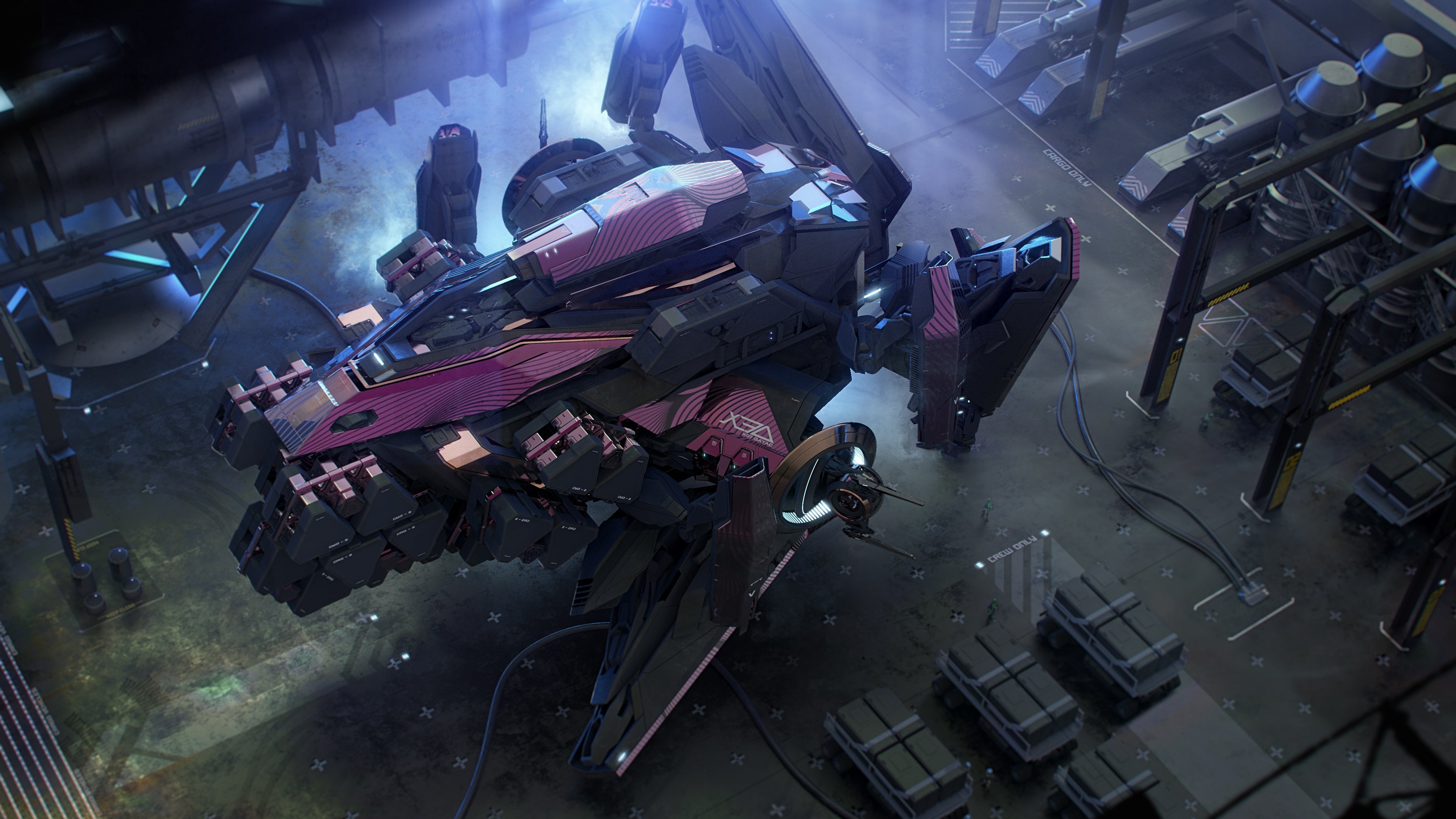
1. Introduction: The Xi'an Freighter That Changes Everything
After five years of waiting, the Gatac Railen is finally coming. Barring a last-minute delay, Star Citizen players will see the first alien cargo ship designed from the ground up for the Human-Xi'an market enter the Persistent Universe during Alien Week 2956 in June 2026. This is not just another cargo ship. It is the first Xi'an vessel that Human pilots can step into and feel at home while still being unmistakably, breathtakingly alien. Every line of its silhouette, every panel of its hull, and every meter of its 67-meter vertical profile declares a design language that no human manufacturer has ever attempted.
The timing is intentional. Cloud Imperium Games has been steadily building toward a 2026 release since late 2025, when the Railen moved from pre-production purgatory into full development momentum. The March 2026 Monthly Report confirmed the critical milestone: the ship had passed its Whitebox review and entered Greybox development. More artists have been assigned to the project. The asset pipeline is converging on a single target. Alien Week is the window, and everything is lining up.
For traders, fleet planners, and grey market investors, this is the moment that separates those who paid attention from those who will pay more later. Ships bought before flyable release almost always appreciate in value. Alien ships, with their limited availability windows, exotic engineering, and collector appeal, frequently see steeper price jumps than their purely human counterparts. The Railen with its newly confirmed 640 SCU cargo capacity, its grav-lev landing system that rewrites the rules of ground operations, and its Xi'an defensive layout that would make a Constellation captain envious represents perhaps the most asymmetric value proposition in the current ship development pipeline.
The numbers tell a brutal story for anyone sitting on the fence. At the current $225 concept price, the Railen delivers 2.84 SCU per dollar. The C2 Hercules, widely considered the gold standard of cargo hauling, delivers 1.74 SCU per dollar at nearly twice the price. The Caterpillar manages 1.75 SCU per dollar. Even the Hull B, the efficiency champion for solo haulers, narrowly edges ahead on cargo-per-dollar metrics while sacrificing every ounce of crew comfort, defensive capability, and atmospheric landing flexibility. The Railen sits in a value pocket that no other ship in the game occupies.
This guide covers everything you need to make an informed decision before Alien Week 2956 reshapes the market. We begin with the Xi'an design philosophy that produced this vessel, move through every technical specification with comparison data, trace the development timeline from CitizenCon 2019 to Greybox 2026, analyze the price history and forecast the Alien Week pricing, break down every viable CCU chain with real dollar figures, evaluate the investment thesis from both bull and bear perspectives, compare grey market pricing across multiple platforms, and end with actionable fleet planning recommendations. Every number in this article is sourced from official CIG communications, the Star Citizen Wiki development timeline, or verified secondary market listings as of May 2026.
2. The Xi'an Design Philosophy: Gatac Manufacture's Human Market Debut
2.1 A Brief History of Xi'an Shipbuilding
To understand the Railen, you must first understand how the Xi'an Empire builds things. Xi'an industrial philosophy differs fundamentally from every human engineering tradition in ways that are both subtle and profound. Where Roberts Space Industries builds for modularity with swappable components and aftermarket customization in mind, and where Drake Interplanetary builds for aggressive cost reduction with the bare minimum required to keep the hull pressurized, the Xi'an Empire builds for longevity measured in centuries, not decades.
A Gatac vessel is not designed for a ten-year service life with periodic refits. It is designed for multi-generational operation, with systems that are meant to be maintained rather than replaced, and a structural philosophy that views the hull as a living platform rather than a consumable chassis. This is not marketing language. It is a structural reality that manifests in every design decision from alloy selection to power distribution architecture.
Gatac Manufacture itself is one of the oldest continuously operating industrial houses in the Xi'an Empire, with a lineage that predates human contact with the Xi'an species by centuries. For generations that span longer than human recorded history, Gatac has produced the logistical backbone of Xi'an civilization: cargo haulers that move raw materials across star systems, mining platforms that extract resources from environments hostile enough to kill unprotected life, and industrial support vessels that serve as mobile factories and repair stations. Their engineering DNA is expressed through three principles that recur across every ship they have ever built.
The first principle is Grav-lev Integration. Rather than relying on wheeled or tracked landing gear which introduces mechanical stress at contact points, requires deployment and retraction mechanisms that add points of failure, and limits landing site options to relatively flat, stable ground, Xi'an vessels employ gravity-manipulation plates mounted on the ventral hull. These plates generate a controlled gravitational field that allows the ship to hover centimeters above any surface regardless of its composition, angle, or stability. Snow, sand, rubble, steep grades, even liquid surfaces: grav-lev plates treat them all identically. For a cargo ship that will spend significant time in frontier landing zones where "paved" is aspirational, this is not a luxury feature. It is an operational necessity.
The second principle is Vertical Orientation. Where human cargo ships tend to sprawl horizontally, extending their cargo grids outward and their hulls across wide footprints, Xi'an vessels build upward. The Railen's 67-meter height against a 53-meter length is not an accident of styling. It is a deliberate engineering choice that minimizes ground footprint while maximizing internal volume, creates natural separation between cargo operations and crew living spaces through vertical deck stacking, and distributes thermal and structural loads along the vessel's longest axis for greater efficiency. This vertical philosophy means the Railen can land in spaces that would be physically impossible for a Caterpillar or C2 Hercules, yet carry comparable cargo volumes.
The third principle is Aesthetic Function. In Xi'an engineering, the distinction between form and function does not exist in the way human engineers imagine it. The distinctive hull patterns that give Xi'an ships their instantly recognizable appearance are not decorative appliques applied after the structural engineering is complete. They are the structural engineering. Each pattern channels energy distribution, each panel angle manages thermal dissipation, and each surface curve optimizes for a specific atmospheric or vacuum performance characteristic. The appearance of a Xi'an ship is a direct, honest expression of what it does and how it does it. You can read a Gatac vessel's capabilities in its silhouette.
2.2 The Interspecies Design Challenge
Building a ship for two species with fundamentally different ergonomics, sensory priorities, and cognitive architectures is one of the hardest design challenges in aerospace engineering. Xi'an are taller and leaner than humans on average, with different joint articulation ranges, different visual spectrum sensitivity, and different intuitive expectations about how controls should map to ship behavior. Their hands have different grip geometries. Their eyes process information at different focal lengths. Their spatial reasoning operates on different axes of priority.
The Railen does not solve this by building a Xi'an ship and bolting a human seat into the cockpit. Nor does it build a human ship with Xi'an styling cues on the exterior. Every control station, every crew berth, every access corridor, and every display interface has been designed from first principles to be operated comfortably by both species simultaneously. The cockpit features dual-calibrated holographic displays that can switch between Xi'an and human visual optimization profiles. The control yokes accept both species' hand geometries through adaptive grip surfaces. The crew quarters include adjustable gravitational zones for sleep posture, recognizing that the two species prefer different spinal alignments during rest cycles.
From the official Q&A with CIG's vehicle team, published alongside the concept sale:
"The Railen is Gatac's first purpose-built human-market offering. Every control interface, every crew station, and every living quarter has been designed to be operated comfortably by both Xi'an and Human crew members. This is not a retrofit or an adaptation. It is a native design."
The cargo system extends this interspecies philosophy into practical logistics. The Railen's uniquely shaped triangular cargo pods open along articulated panels to accept standardized 32 SCU shipping containers, the universal cargo unit of the United Empire of Earth. This means the Railen can dock at any UEE cargo terminal, accept cargo from any standard freight elevator, and integrate into existing trade infrastructure without requiring specialized handling equipment. The Xi'an engineering is under the skin. The interface is universal.
2.3 Gatac's Strategic Position
Gatac Manufacture's entry into the human market with the Railen is not a casual product launch. It represents a strategic decision by one of the Xi'an Empire's oldest industrial houses to establish a permanent bridgehead in human space. The Railen is the first product, but it will not be the last. Understanding this context matters because it affects long-term support, parts availability, and cross-compatibility with future Gatac products. A manufacturer that has committed to the human market for the long term will maintain supply chains, update designs for regulatory compliance, and build service networks. A manufacturer treating the Railen as a one-off experiment will not.
All available evidence suggests Gatac is playing the long game. The Railen's design documentation references human regulatory standards directly. The Galactapedia entry was updated well before the concept sale, indicating long-lead content planning. The decision to double cargo capacity mid-development, rather than ship the original 320 SCU spec and iterate later, suggests a manufacturer that wants to arrive in the human market with a competitive product, not a minimal viable one.
3. Technical Specifications: Every Number That Matters
3.1 Dimensions, Mass, and Physical Footprint
| Specification | Railen | C2 Hercules | Caterpillar | Constellation Taurus |
|---|---|---|---|---|
| Length | 53 meters | 94 meters | 111 meters | 61 meters |
| Width | 52 meters | 51 meters | 39 meters | 27 meters |
| Height | 67 meters | 23 meters | 14 meters | 14 meters |
| Mass | ~800,000 kg (est.) | 970,000 kg | 1,600,000 kg | 430,000 kg |
| Ground Footprint | ~2,750 m² | ~4,800 m² | ~4,300 m² | ~1,650 m² |
The Railen's dimensions reveal a ship that has been optimized for a specific operational profile: planetary cargo operations from non-standard landing zones. At 53 meters long, it is shorter than a Constellation Taurus, meaning it can fit into hangars and landing bays that larger freighters cannot access. The 52-meter width provides exceptional lateral stability during atmospheric flight, distributing lifting surface area across a broader span than any human cargo ship in its class. And the 67-meter height places the cockpit far above ground level, providing the pilot with an unobstructed view of the landing zone in all directions, a critical advantage when setting down on unprepared surfaces with obstacles, debris, or uneven terrain.
Contrast this with the Caterpillar, which at 111 meters long and only 14 meters high requires long, flat approaches and struggles with vertical landing zones. Or the C2 Hercules, which at 94 meters needs enormous hangar bays and cannot operate from many planetary outposts. The Railen's vertical orientation is not a styling choice. It is a deliberate engineering decision that trades horizontal sprawl for vertical presence, enabling operations from locations that competitors simply cannot reach.
3.2 Propulsion and Flight Systems
| Component | Specification | Notes |
|---|---|---|
| Main Thrusters | 2x Xi'an ion-plasma engines (Gatac proprietary) | High-efficiency long-burn design optimized for sustained cargo runs |
| Maneuvering Thrusters | Multi-vector articulated thrust array | 12+ individual thrust ports with gimbaled nozzles |
| Landing System | 4x ventral grav-lev manipulator plates | Zero ground-contact stress, hovers above any surface type |
| Quantum Drive | Medium-class S2 Xi'an quantum drive | Expected range: 80-100 GM on a single fuel tank |
| Atmospheric Speed | ~220 m/s SCM (estimated) | Comparable to Constellation class for atmospheric handling |
The grav-lev landing system is the Railen's most distinctive engineering feature and deserves more than a passing mention. Traditional landing gear whether wheeled, tracked, or skid-based introduces mechanical complexity at the most vulnerable moment of any flight: the transition from flight to ground contact. Landing gear must deploy correctly, absorb the impact of touchdown, distribute the ship's mass across a small number of contact points, and then retract without jamming when it is time to leave. Every one of these steps is a potential failure point. Every failure is expensive.
Grav-lev plates eliminate the entire problem category. As the Railen descends toward a surface, the ventral gravity manipulators activate automatically, generating a controlled repulsive field that arrests descent centimeters above the ground. The ship does not touch down. It hovers. The field adjusts continuously to surface irregularities, meaning the Railen can land on terrain that would snap a Caterpillar's landing gear or tip a Freelancer onto its side. When it is time to depart, the plates simply increase output and the ship rises. There is nothing to deploy, nothing to retract, and nothing to break.
For traders operating in frontier systems with minimal infrastructure, this is transformative. A landing zone that would be impassable to a C2 becomes accessible to a Railen. A mining outpost with no paved landing pad can still receive cargo deliveries. Emergency landings on unprepared terrain carry dramatically lower risk of structural damage. The grav-lev system is not a gimmick. It is a genuine operational advantage that changes where and how the Railen can be used.
3.3 Cargo Capacity: The 640 SCU Game-Changer
This is the number that reset every conversation about the Railen's value proposition. When John Crewe confirmed during an August 2025 Star Citizen Live Q&A that the cargo capacity was going "way up" from the original 320 SCU estimate, the community recalibrated instantly. The IAE 2955 display in November confirmed the exact figure: 640 SCU, exactly double the concept specification.
| Milestone | Date | SCU | Context |
|---|---|---|---|
| CitizenCon 2019 | November 2019 | ~320 (est.) | Announced as "Vehicle 2" — cargo capacity comparable to Hull B class |
| Concept Sale | June 2021 | 320 | Triangular pods designed for Xi'an cargo formats |
| Crewe Q&A | August 2025 | "Way up" | Confirmed redesign for standard 32 SCU containers; capacity significantly increased |
| IAE 2955 | November 2025 | 640 | Official Pledge Store update; info panel notes "double the cargo capacity of earlier prototypes" |
The cargo is distributed across multiple triangular pods mounted along the ventral hull structure. These pods are fixed points, not detachable modules like the Hull series external grid. Each pod opens through articulated panel mechanisms, revealing internal bays sized to accommodate standard 32 SCU cargo containers. The triangular geometry is not arbitrary. It maximizes internal volume within the pod's structural envelope while providing natural stacking angles that help secure cargo during atmospheric turbulence and combat maneuvering. The pods also serve as thermal management surfaces, with their angled profiles designed to radiate heat efficiently during sustained quantum travel.
The 640 SCU figure places the Railen in a unique competitive position. It carries more cargo than the Caterpillar at 576 SCU and nearly matches the C2 Hercules at 696 SCU, while costing significantly less than either ship. It offers considerably more cargo than the Constellation Taurus at 174 SCU, making it a natural upgrade path for Constellation owners who have outgrown their ship's hold but do not want to pay C2 prices. And against the Hull B at 384 SCU, the Railen trades a lower cargo-per-dollar ratio for vastly superior crew amenities, defensive capability, atmospheric handling, and landing flexibility. The trade is almost always worth making.
| Ship | Cargo (SCU) | Crew | RSI Store Price | SCU per Dollar | Vehicle Transport |
|---|---|---|---|---|---|
| Freelancer MAX | 120 | 1-2 | $150 | 0.80 | Small (ROC fits) |
| Constellation Taurus | 174 | 1-4 | $190 | 0.92 | Yes (Ursa-class) |
| Hull B | 384 | 1 | $140 | 2.74 | No |
| Railen | 640 | 1-4 | $225 | 2.84 | No (cargo only) |
| Caterpillar | 576 | 1-4 | $330 | 1.75 | Limited (modules) |
| C2 Hercules | 696 | 1-2 | $400 | 1.74 | Yes (Tonk-class) |
At 2.84 SCU per dollar, the Railen is the most cargo-efficient multi-crew ship in the game. The Hull B edges it out on raw efficiency, but the Hull B is a solo ship with no interior beyond a cockpit, no defensive armament of any kind, and a cargo grid that is completely exposed to space. The Railen achieves near-Hull-B efficiency while providing a full interior, crew quarters, dual turrets, missile racks, and the ability to operate in atmosphere with full cargo. No other ship in the game offers this combination of capacity, capability, and price.
3.4 Defensive Systems: Xi'an Combat Philosophy
| System | Railen | Constellation Andromeda | C2 Hercules | Caterpillar |
|---|---|---|---|---|
| Turrets | 2x Manned (2x S4 each) | 2x Manned (2x S2 each) | 2x Remote (2x S3 each) | 2x Manned (2x S3 each) |
| Total Turret DPS | 4x S4 weapons | 4x S4 pilot + 4x S2 turret | 4x S3 weapons | 4x S3 weapons |
| Missiles | 2x S4 + 2x S3 racks | 2x S2 + 2x S1 racks | None | None |
| Shields | 2x L (est. S3 Xi'an) | 1x L | 2x L | 2x L |
The Railen's defensive layout tells a story about Xi'an combat philosophy. Human ships tend to concentrate firepower forward, treating cargo defense as an afterthought at best. The Railen mounts two turrets, each carrying a pair of Size 4 weapons, with overlapping fields of fire that cover the entire ventral and rear arcs. This is not a ship designed to chase down enemies. It is a ship designed to make anyone following it regret the decision.
Four Size 4 weapons represent significant firepower. The Constellation Andromeda, considered well-armed for a multi-role ship, mounts four Size 4 weapons on pilot-controlled gimbals plus turret-mounted Size 2s. The Railen brings the same Size 4 count, distributed across remote turrets rather than pilot control. For a dedicated cargo ship, this is exceptional. Pure freighters like the Hull series sacrifice weapons entirely for cargo capacity. The Railen refuses that trade-off, and the result is a freighter that can meaningfully defend itself.
The missile complement of two Size 4 and two Size 3 racks provides standoff engagement capability against medium threats. Xi'an missile systems historically emphasize speed and agility over raw payload, prioritizing hit probability against maneuvering targets. Combined with what are expected to be S3 Xi'an shield generators which historically emphasize rapid recharge cycling over maximum raw capacity, the Railen is equipped to survive long enough in a combat engagement to reach quantum jump altitude and escape. It is not a warship. It is a freighter that can make attacking it an expensive proposition.
4. Crew and Interior: Living in a Xi'an Ship
4.1 Crew Requirements and Solo Viability
| Role | Minimum | Optimal | Function |
|---|---|---|---|
| Pilot | 1 | 1 | Flight control, navigation, quantum plotting |
| Co-pilot / Engineer | 0 | 1 | Power distribution, shield management, cargo monitoring |
| Turret Gunner (Port) | 0 | 1 | Port-ventral turret operation |
| Turret Gunner (Starboard) | 0 | 1 | Starboard-ventral turret operation |
| Total | 1 | 4 |
One of the Railen's most underrated strengths, a feature that is almost never discussed in comparison threads, is its solo viability. While optimal operation requires four crew members, a single pilot can fly the ship, manage cargo manifests, plot quantum routes, and operate safely in secured systems like Stanton, Terra, or Magnus without any crew support whatsoever. The turrets can be slaved to pilot control for limited defensive capability, or simply left unmanned in safe space where threats are minimal.
For traders who primarily operate in high-security systems with established trade routes, the Railen functions effectively as a solo freighter with 640 SCU of capacity. That capacity previously required either a fully-crewed Caterpillar, a C2 with a co-pilot, or a Hull C with all the operational limitations that external cargo grids impose. The Railen delivers endgame cargo capacity in a solo-operable package. No other ship in the game offers this combination.
4.2 Interior Layout: A Vertical City
The Railen's interior is organized across five vertical zones connected by a central access core that runs the full height of the vessel. This vertical arrangement is foreign to pilots accustomed to the horizontal corridors of human ships, but it creates natural separation between operational zones that human ships achieve only through compartmentalization:
Cockpit Deck (Top Zone) — Positioned at the vessel's apex, the twin-seat bridge offers the pilot and co-pilot panoramic visibility in every direction. The cockpit is the highest point on the ship, meaning there is no hull structure above or in front of the viewports to obstruct sight lines. During landing operations on rough terrain, the pilot can see the landing zone directly below by looking down through the forward viewport, a capability that ships with forward-mounted cockpits and ventral landing gear cannot match. The displays use Xi'an holographic technology with human-readable overlay interfaces that can be toggled between species profiles.
Crew Quarters (Upper-Mid Zone) — Four individual berths provide private rest space for each crew member. The quarters feature Xi'an aesthetic throughout, with curved wall surfaces, integrated lighting that follows the hull's natural lines, and materials chosen for both acoustic damping and thermal regulation. Each berth includes adjustable sleep surfaces accommodating both species' preferred rest postures, personal storage compartments sealed against vacuum and fire, and independent environmental controls. The quality of these quarters exceeds that of any human cargo ship in the game—the Caterpillar's crew accommodations are spartan by comparison, and the C2 offers no dedicated crew quarters at all.
Common Area and Galley (Mid Zone) — The shared living space serves dual functions as mess hall and mission planning center. A central table surrounded by seating for all four crew members functions as both dining surface and holographic planning station, capable of projecting trade routes, cargo manifests, and system maps. The galley includes food preparation facilities compatible with both species' nutritional requirements, with separate storage for human and Xi'an consumables. Long-duration cargo runs between distant systems become viable when the crew has a space to eat, plan, and decompress together.
Engineering Deck (Lower-Mid Zone) — Component access is concentrated here, with all major ship systems accessible through standardized maintenance panels. The power plant, dual shield generators, quantum drive, and life support systems are arranged for efficient access by maintenance crews of either species. Xi'an component architecture emphasizes accessibility, with clearly marked access points, color-coded power conduits, and physical isolation between high-energy systems and crew-accessible paths.
Cargo Control (Lower Zone) — The lowest crew-accessible deck provides direct interfaces with the cargo pod systems. From this station, operators can monitor individual pod status including internal temperature, atmospheric composition, structural integrity, and cargo mass distribution. The gravity plate distribution can be adjusted per pod to compensate for uneven loading, and environmental controls within each pod can be set independently for cargo that requires specific atmospheric conditions. The physical cargo pods are accessed externally, but all monitoring and control happens from this central station.
5. Development Timeline: Six Years to Flyable
The Railen's journey from announcement to near-release spans more than six years, tracing the evolution of CIG's ship production pipeline from early concept through to the refined Greybox-to-flyable workflow that has delivered ships like the Spirit series and the Syulen in recent years. Every date matters because it tells the story of when and how the Railen became what it is today.
| Date | Milestone | Significance |
|---|---|---|
| 2019-11-23 | Announced at CitizenCon 2949 as "Vehicle 2" | First public acknowledgment of a Xi'an cargo ship. Estimated size comparable to Hull B or Freelancer MAX. No name, no manufacturer, no artwork. Pure concept tease. |
| 2021-05-26 | Gatac Manufacture Galactapedia entry updated | Lore foundation laid for the manufacturer. The updated entry included references to Gatac's human-market ambitions, foreshadowing the Railen reveal. |
| 2021-06-10 | Name "Railen" revealed via RSI Instagram | First confirmed name. Xi'an proper name: 9sanrai0len, literally "Ship that hauls peacefully." |
| 2021-06-11 | Concierge-exclusive early concept sale | Price: $200 with LTI. Concierge-exclusive "Hyaotan" paint offered at $11 (black with blue highlights). First concept images released. |
| 2021-06-12 | Public concept sale opens | Same $200 price point. Standard LTI inclusion. Full Q&A published alongside sale. |
| 2023-05-26 | Scheduled for production in 2024 | First official production timeline. Asset planning begins; concept art refined for production handoff. |
| 2025-07-03 | Pre-production begins | Work distributed across departmental tasks. Concept art finalization, technical design validation, material library development for Xi'an aesthetic. |
| 2025-08-21 | John Crewe confirms 32 SCU container support; capacity going "way up" | Pivotal moment. Cargo pod redesign from Xi'an-specific containers to universal 32 SCU standard. Community recalibrates Railen from "interesting alien ship" to "potential meta freighter." |
| 2025-11-20 | IAE 2955: Pledge Store updated to 640 SCU | Official doubling confirmed. Info panel: "With an astounding double the cargo capacity of earlier prototypes." Store price updated to $225. |
| 2026-01-21 | Full production begins; Whitebox development | Asset production ramps. Whitebox modeling of all interior and exterior volumes underway since mid-November 2025. |
| 2026-02-04 | Whitebox review expected | Internal review gate for spatial layout validation. All volumes confirmed correct before detail pass begins. |
| 2026-03-04 | Whitebox passed. Greybox underway. Additional artists assigned for Alien Week. | Production enters final art phase. Team expanded in preparation for Alien Week release window. Greybox means all geometry exists; now texturing, lighting, and VFX begin. |
| 2026-06 (est.) | Alien Week 2956 — targeted flyable release | Projected release window. From Greybox to flyable in approximately four months, consistent with recent ship release cadence. |
Three observations from this timeline demand attention. First, the production velocity has accelerated dramatically. The ship moved from pre-production to Greybox in roughly six months from July 2025 to March 2026, a pace that would have been unthinkable during the early concept phase and that indicates CIG is prioritizing this release within the vehicle pipeline. Second, the 640 SCU redesign happened remarkably late November 2025, well after the original concept sale and pre-production planning. CIG made a deliberate strategic decision to reposition the ship upward in the cargo hierarchy rather than executing the original specification. This speaks to confidence in the design and a recognition that the original 320 SCU figure was underselling the ship's potential. Third, the Greybox-to-Alien-Week timeline gives approximately four months for final art passes, which is tight but achievable, consistent with the Syulen's development timeline from Greybox to flyable.
6. Price History and Alien Week 2956 Forecast
6.1 Concept-to-Flyable Price Trajectory
| Sale Event | Date | Price | Insurance |
|---|---|---|---|
| Concierge Early Concept | June 2021 | $200 | LTI |
| Public Concept | June 2021 | $200 | LTI |
| Current Store (IAE 2955+) | November 2025+ | $225 | LTI (concept window) |
| Alien Week 2956 (predicted) | June 2026 | $260–$280 | 10-Year / LTI (warbond) |
6.2 Historical Comparison: Concept-to-Flyable Price Increases
Ship price increases at flyable release are not speculation. They are an established pattern that has held across every vehicle CIG has brought from concept to flyable status. The percentages tell the story:
| Ship | Concept Price | Flyable Price | Increase | Notes |
|---|---|---|---|---|
| Mercury Star Runner | $225 | $260 | +15.6% | Size increase during development |
| Hercules C2 | $360 | $400 | +11.1% | No significant design changes |
| Redeemer | $250 | $325 | +30.0% | Role expansion during development |
| 400i | $220 | $250 | +13.6% | Standard luxury-class increase |
| Scorpius | $220 | $240 | +9.1% | Minimal design changes, fast development |
| Spirit C1 | $110 | $125 | +13.6% | Standard increase, no major changes |
| Average | +15.5% | |||
| Railen (predicted) | $225 | $260–$280 | +15.6–24.4% | 640 SCU upgrade justifies upper range |
The Railen case for the upper end of this range is strong. CIG nearly doubled the cargo capacity after the concept sale, a capability increase far more significant than the MSR's size increase or the Redeemer's role expansion. The 640 SCU figure places the Railen in direct competition with ships costing significantly more, and CIG's pricing philosophy has consistently adjusted to reflect capability rather than concept-era estimates. A $280 flyable price represents a 24.4% increase, which places the Railen between the 400i at $250 and the Constellation Aquila at $310—a reasonable price band for a 640 SCU alien freighter with dual S4 turrets and grav-lev landing capability.
The conservative estimate of $260 reflects the scenario where CIG applies the standard concept-to-flyable multiplier without additional premium for the cargo upgrade. Both scenarios represent a significant increase from the current $225 price, and both scenarios reward buyers who acquire the ship before Alien Week.
6.3 Grey Market Post-Release Dynamics
Alien ships exhibit unique grey market behavior. Because RSI store availability is restricted to Alien Week and IAE events, secondary market supply contracts between these windows. Buyers who missed the June window must either wait until November or pay grey market premiums. This dynamic creates predictable price patterns: prices stabilize at or slightly above flyable RSI store price immediately post-release, then gradually rise as available inventory is absorbed by the market between events.
The Banu Defender followed this exact pattern. Concept price of $185 rose to $220 at flyable release, then settled into a grey market range of $180–$230 depending on insurance type and availability. The Railen, with dramatically higher utility through its 640 SCU cargo role, is likely to maintain or exceed its flyable price on the secondary market rather than settling below it. A ship that earns its keep as a freighter has persistent demand. A ship that is purely a combat vessel depends on meta relevance.
7. CCU Chain Strategies: Building Your Railen Below Store Price
7.1 The Taurus Bridge Strategy
The most practical and widely used path to a discounted Railen uses the RSI Constellation Taurus as a bridge ship. The logic is straightforward: the Taurus is always available in the RSI store at $190, and the Taurus-to-Railen CCU gap is currently $35 when the Railen is available for purchase. By acquiring the Taurus now and the CCU when the Railen next appears in-store, you lock in the current price gap before the flyable increase widens it.
| Step | Action | Cost | Running Total |
|---|---|---|---|
| 1 | Buy RSI Constellation Taurus (standalone) | $190.00 | $190.00 |
| 2 | Buy Taurus → Railen CCU (when Railen is in store) | $35.00 | $225.00 |
| 3 | Fly Taurus immediately; apply CCU when Railen launches | $0.00 | $225.00 |
The beauty of this strategy is that you get a flyable cargo ship with 174 SCU today while securing your Railen upgrade at the concept price gap. When the Railen's store price rises to $260–$280, the Taurus-to-Railen CCU gap will widen to $70–$90. Buyers who acquire the CCU before that increase save $35–$55 on the upgrade alone.
7.2 Advanced Warbond CCU Stacking
For investors and experienced fleet builders willing to play the long game across multiple sales events, CCU stacking can reduce the effective cost of a Railen with LTI to significantly below store price. This strategy requires patience, event calendar awareness, and a willingness to hold unrealized CCU value in your hangar for months:
| Step | Upgrade | Acquire During | Est. Cost | Savings |
|---|---|---|---|---|
| 1 | LTI Token (any cheap LTI ship/vehicle) | Any concept sale | $40–$55 | Baseline |
| 2 | LTI Token → Prospector | IAE warbond discount | $5–$10 (gap) | $5–$10 vs. normal CCU |
| 3 | Prospector → Taurus | Invictus warbond discount | $10–$15 (gap) | $10–$15 vs. normal CCU |
| 4 | Taurus → Railen | Before Alien Week price increase | $35 (gap at $225) | $35–$55 vs. post-increase gap |
| Total | $90–$115 | $110–$135 vs. flyable store price |
The total effective cost of $90–$115 for an LTI Railen represents roughly half the expected flyable store price. This is not hypothetical. CCU stacking has been a core grey market strategy for years, and the Railen's position in the upgrade chain—below the Constellation class and above common starting ships—makes it an ideal target for stacking. The key risk is timing: you must acquire each CCU during its respective discount window, and you must secure the final Taurus-to-Railen CCU before the Alien Week price increase takes effect.
7.3 Acquisition Path Comparison
| Approach | Cost Range | LTI | Melt Value | Buyback | Immediate Ship | Complexity |
|---|---|---|---|---|---|---|
| RSI Store Direct | $225 | Yes | $225 | Yes | No (concept) | Low |
| Taurus Bridge CCU | $225–$235 | Yes | $225–$235 | Yes | Yes (Taurus) | Low |
| Warbond CCU Stacking | $90–$115 | Yes | $225+ (total melt) | Partial | Varies | High |
| Grey Market CCU'd | $202–$260 | Usually | No | No | No | Low |
| Grey Market OC LTI | $380–$400 | Yes | Yes | Yes | No | Low |
For most buyers, the Taurus Bridge strategy offers the best balance of cost, simplicity, and immediate utility. You pay approximately the concept price, you get a flyable cargo ship today, and you lock in the concept-price CCU gap. For investors willing to plan across multiple sale events, warbond stacking can reduce the effective cost dramatically but requires months of execution.
8. Investment Thesis: Bull Case, Bear Case, and Verdict
8.1 The Bull Case
Unmatched value density. At 640 SCU for $225, the Railen delivers 2.84 SCU per dollar. No multi-crew ship in the game approaches this ratio. The Hull B at 2.74 SCU per dollar is the only competitor, and it accomplishes this by sacrificing every other capability. The Railen achieves near-Hull-B cargo efficiency while providing full crew amenities, meaningful defensive armament, atmospheric flight capability, and the ability to land on unprepared terrain. If you believe that cargo capacity drives earning potential in Star Citizen's economy, the Railen is mathematically the best investment in the game at its current price.
Confirmed price increase trajectory. CIG has never released a flyable ship without a price increase, and alien ships have historically seen increases at or above the average. The 640 SCU redesign provides CIG with strong justification to push toward the upper end of the historical range. A $280 flyable price is conservative based on capability-per-dollar comparisons with the C2 Hercules and Caterpillar.
Artificial supply constraints. Alien ships are not always available. Once the Railen launches, it will only appear in the RSI store during Alien Week in June and IAE in November. Between these windows, grey market supply naturally tightens, creating upward price pressure that persists year-round.
The collector premium. Alien ships attract buyers who do not care about SCU-per-dollar calculations. The Railen is the first Human-Xi'an cargo ship, a historical novelty that will draw collectors alongside practical traders. Collector demand adds a price floor that pure utility ships do not enjoy. A Caterpillar is a tool. A Railen is a statement.
8.2 The Bear Case
Greybox is not flyable. While the March 2026 report confirms Greybox, the transition from Greybox to flyable involves art finalization, lighting passes, VFX implementation, flight model tuning, and game integration. Four months from Greybox to flyable is tight. A delay past Alien Week to IAE 2956 in November is plausible. Buyers who need a cargo ship immediately should consider this risk.
Unknown flight model. The Railen's vertical orientation, grav-lev landing, and Xi'an thruster architecture have no direct analogue among currently flyable ships. The Khartu-al and Santok.yai are combat ships with entirely different handling profiles. Early adopters will discover how the Railen handles in atmosphere and space at the same time as everyone else. A ship optimized for planetary cargo landings may handle differently than expected in combat or during quantum interdiction escapes.
Evolving cargo gameplay. The Railen's 640 SCU capacity assumes fully functional cargo loading, unloading, and trading mechanics. Physicalized cargo loading, which requires players to manually move containers onto and off of ships, will affect how quickly a Railen can be loaded compared to a C2 with its wide-open bay or a Hull C with automated spindle systems. The triangular pod design, while maximizing internal volume, may introduce loading throughput limitations that simpler ships avoid.
Competition from proven ships. For traders who need a freighter today, the C2 Hercules for $400 or Taurus for $190 are flyable, proven, and fully integrated into the current economy. The Railen's entire value proposition depends on future features and an unreleased ship. If CIG's cargo refactor changes the meta, the Railen could arrive into a very different trading environment than the one it was designed for.
8.3 Verdict
For backers with a budget of $225–$260 who want exposure to a unique cargo ship with strong appreciation potential, the Railen is a buy. The risk-reward profile is favorable: the concept price is already justified by the 640 SCU upgrade alone, and alien ships have historically been safe investments with limited downside even in worst-case delay scenarios. The maximum downside risk is a delay from Alien Week to IAE, which represents a six-month holding period on an asset that still appreciates at flyable release.
For backers who need a cargo ship immediately, the Taurus Bridge strategy provides the best of both worlds: a flyable freighter today plus a locked-in upgrade path to the Railen when it launches.
For pure investors, the window is now. Before Alien Week 2956. Once the RSI store relists the Railen at a higher flyable price, the 15-24% concept-to-flyable arbitrage closes permanently.
9. Grey Market Pricing: Where to Buy
| Listing Type | Price Range | Insurance | Melt Value | Buyback Eligible | Platform |
|---|---|---|---|---|---|
| CCU'd (LTI token base) | $202–$260 | LTI | Usually no | No | Star-Hangar, r/Starcitizen_trades |
| CCU'd Standalone | $202.99+ | LTI / 120M | No | No | ORONST ORBITAL |
| Original Concept LTI | $380–$400 | LTI | Yes | Yes | Star-Hangar, Space Foundry |
| Original Concept LTI | $389.99 | LTI | Yes | Yes | ORONST ORBITAL |
| RSI Store (when available) | $225 | LTI (concept) | Yes | Yes | RSI Pledge Store |
ORONST ORBITAL currently offers the Railen as a CCU'd Standalone Ship starting at $202.99, representing the most competitive entry point identified across verified grey market platforms. This pricing undercuts equivalent Star-Hangar listings by $50–$60 on average. For collectors seeking the pure original concept with full melt and buyback eligibility, we also carry the Original Concept LTI Railen at $389.99 with full RSI account integration.
10. Alien Week 2956: What to Expect
10.1 Event Schedule
Alien Week 2956 is projected to run in mid-June 2026, approximately two to three weeks after the conclusion of Invictus Launch Week. This follows the established annual cadence where Invictus occupies late May and Alien Week follows in June, creating a six-week period of continuous ship sales and event activity that represents the busiest time in the Star Citizen calendar outside of IAE in November.
The exact dates have not been announced as of May 2026, but the pattern is reliable. Invictus 2956 is expected to run from approximately May 20 through June 1, placing Alien Week 2956 in the June 12–22 window. CIG typically announces exact dates two to three weeks in advance through the weekly "This Week in Star Citizen" communication.
10.2 Railen Launch Content
Based on established patterns for flyable alien ship releases, expect the Railen launch to include:
- Pledge Store Availability — Railen standalone and CCU options available with 10-year insurance standard, LTI for warbond (new cash) purchases. Price expected at $260–$280.
- New Paint Selection — CIG typically releases three to four new liveries alongside a flyable debut. Xi'an-themed color palettes are expected: deep emerald greens, iridescent purples, metallic golds, and possibly a returning Hyaotan variation for Concierge backers.
- In-Game Purchase Option — The Railen will likely be purchasable with aUEC at a major ship dealer (New Deal in Lorville or Astro Armada in Area18) concurrent with the pledge store release, priced at approximately 6–8 million aUEC.
- Cinematic Commercial — Alien ships receive high-production-value trailers during their event week. Expect a Railen-focused commercial showcasing the grav-lev landing system, cargo operations, and the Xi'an interior at cinematic quality.
- Subscriber Promotion — Subscribers may receive a Railen-themed flair item, poster, or armor set during Alien Week.
10.3 Full Alien Week Ship Lineup
Alien Week brings all alien-manufacturer ships back to the pledge store simultaneously. The confirmed and expected lineup for 2956:
| Manufacturer | Species | Ships Expected |
|---|---|---|
| Gatac Manufacture | Xi'an | Railen (flyable debut), Syulen |
| Aopoa | Xi'an | Khartu-al, Santok.yai, Nox, Nox Kue |
| Banu | Banu | Defender, Merchantman (concept update) |
| Esperia | Tevarin (reproductions) | Prowler, Talon, Talon Shrike, Blade |
| Esperia / Vanduul | Vanduul (captured) | Glaive, Scythe (limited stock) |
The Railen is the confirmed headliner. CIG has not announced additional flyable alien debuts for the event, though the Banu Merchantman may receive a development update given its long concept-to-production timeline.
11. Fleet Planning: Where the Railen Fits
11.1 Solo Trader Fleet Architecture
| Ship | Role | SCU | Use Case |
|---|---|---|---|
| Railen | Primary Freighter | 640 | High-value commodity runs, safe space, long-haul inter-system trading |
| Freelancer MAX | Medium Freighter | 120 | Medium risk routes, smaller landing zones, solo operation in higher threat areas |
| Prospector / Vulture | Income Generation | 32 / 12 | Raw material production: mined ore or salvaged materials feed into the Railen for bulk sale |
11.2 Multi-Crew Trade Fleet
| Ship | Role | Crew | Notes |
|---|---|---|---|
| Railen | Primary Freighter | 1-4 | Fleet anchor; carries bulk of high-value cargo |
| Constellation Andromeda | Escort Freighter | 1-4 | Armed cargo support with snub fighter; provides mobile defense platform |
| Vanguard Sentinel / Harbinger | Long-Range Escort | 1-2 | Extended quantum range to match Railen; heavy anti-fighter capability |
11.3 The Railen-C2 Decision Matrix
The most common question in cargo fleet planning forums: Railen or C2 Hercules? The answer depends on your priorities:
| Decision Factor | Railen | C2 Hercules | Winner |
|---|---|---|---|
| Cargo Capacity | 640 SCU | 696 SCU | C2 (+56 SCU) |
| Price | $225 (now) / $260-280 (flyable) | $400 | Railen (-$120 to -$175) |
| SCU per Dollar | 2.84 | 1.74 | Railen (+63%) |
| Vehicle Transport | No | Yes (Tonk-class) | C2 |
| Turret Firepower | 4x S4 | 4x S3 | Railen |
| Missiles | Yes (S4+S3 racks) | No | Railen |
| Crew Minimum | 1 | 1 | Equal |
| Availability | Limited (Alien Week + IAE) | Always available | C2 |
| Landing Flexibility | Grav-lev (any surface) | Wheeled gear (prepared surfaces) | Railen |
| Current Status | Greybox (June 2026) | Flyable | C2 |
| Investment Upside | High (pre-flyable appreciation) | Low (mature, stable pricing) | Railen |
The C2 wins on immediate availability, vehicle transport capability, and a marginal 56 SCU advantage. The Railen wins on price, cargo-per-dollar efficiency, firepower, landing flexibility, and investment upside. For backers who need a freighter today that can also carry ground vehicles, the C2 is the answer. For everyone else, the Railen is the mathematically superior choice.
12. Post-Release Gameplay: How the Railen Plays
12.1 The Cargo Loop
When the Railen enters the Persistent Universe at Alien Week 2956, its operational profile will differ meaningfully from every cargo ship currently flyable. The combination of vertical orientation, grav-lev landing, and articulated cargo pods creates a workflow that rewards planning and patience while penalizing rushed, disorganized approaches to cargo management.
The Railen's cargo operation begins at the terminal. Like all current freighters, you purchase commodities at a trade kiosk and the cargo is made available at the ship's designated cargo access points. Unlike the C2 Hercules, where cargo is deposited in a single enormous open bay, or the Caterpillar, where each module has its own access point, the Railen's triangular pods each require individual access and loading. This means the loading process takes longer but provides granular control over cargo organization. A trader who separates high-value commodities from bulk filler, who balances mass distribution across pods for optimal atmospheric handling, and who loads the most frequently accessed pods first will extract more value per run than a trader who treats all 640 SCU as an undifferentiated pile.
The grav-lev landing system dramatically changes where cargo runs are viable. A C2 Hercules cannot land on a steep mountain mining outpost with no paved pad. A Caterpillar needs a flat, long approach that many frontier bases simply do not have. The Railen can descend onto a rubble-strewn plateau, hover centimeters above the ground while cargo is loaded, and lift off without ever making physical contact. This opens trade routes that are physically inaccessible to competing freighters. Mining outposts on Aberdeen, outposts on microTech's frozen tundra, emergency supply drops to remote research stations, all become viable with a Railen in ways they are not with a C2 or Caterpillar.
12.2 Atmospheric Flight and Combat Survival
The Railen's vertical profile creates handling characteristics that no human freighter replicates. The 67-meter height distributes mass along the vessel's longest axis, creating a center of gravity that is higher than any comparable cargo ship. This affects atmospheric banking, turn radius, and the speed at which the ship can roll without losing control authority. Pilots accustomed to the C2's wide, stable flight profile or the Caterpillar's sluggish but predictable handling will need to adapt. The trade-off is visibility: the elevated cockpit provides an unobstructed view of the landing zone below and ahead, making precision landings on irregular terrain significantly easier than in any forward-cockpit freighter.
In combat, the Railen is designed to escape rather than engage. The dual S4 turrets create a lethal cone of fire to the rear and ventral arcs, punishing anyone who follows too closely. The missile racks provide standoff deterrence against medium fighters and cutlasses that might otherwise attempt to close distance. The Xi'an shield generators, which prioritize rapid recharge cycling over maximum capacity, mean that the Railen can take hits, regenerate, and take more hits during a sustained pursuit scenario lasting minutes rather than seconds. A determined attacker with sufficient firepower will eventually overwhelm the shields, but the Railen's defensive philosophy is not about winning fights. It is about surviving long enough to escape them.
The survival protocol for a Railen under attack is: drop decoys, activate shield boost to the rear facing, angle toward the nearest quantum marker, and trust the turrets to keep pursuers at range while the quantum drive spools. This is not a warship. It is a freighter that has been given the tools to make attacking it a time-consuming and ammunition-wasteful proposition rather than a guaranteed payday.
12.3 Long-Haul Trade Routes
The Railen's projected quantum fuel capacity of 80-100 GM on a single tank positions it for inter-system cargo routes that shorter-legged ships cannot economically run. The Crusader-to-microTech run, for example, requires roughly 55 GM of quantum fuel. A Freelancer MAX can make this run but burns through most of its fuel budget doing so, leaving no margin for diversions or combat evasion. The Railen can run Crusader-to-microTech, then continue to ArcCorp or Hurston on the same tank, enabling multi-stop trade loops that dramatically improve credits-per-hour compared to single-route ships that must refuel after every leg.
Future system expansions will only increase the value of long-range cargo capability. When Pyro becomes fully integrated into the live economy, routes between Stanton and Pyro gateway stations will require ships with the fuel capacity to cross the jump point, execute the in-system transit to a secure trade hub, and return with cargo without refueling in hostile territory. The Railen's fuel budget, combined with its defensive armament and grav-lev landing flexibility, positions it as one of the most economical choices for these emerging long-haul routes that will define Star Citizen's economy for years after release.
13. Railen vs. The Competition: Detailed Head-to-Head
13.1 Railen vs. Caterpillar
The Caterpillar at $330 and 576 SCU is the Railen's closest competitor in price and role. Both are multi-crew freighters with defensive turrets, crew amenities, and modular design philosophies. But the comparison breaks decisively in the Railen's favor on almost every metric. The Railen carries 64 more SCU for $105-$130 less. It mounts Size 4 weapons on its turrets against the Caterpillar's Size 3s. It carries missiles against the Caterpillar's none. It lands on grav-lev plates against the Caterpillar's conventional landing gear that requires long, flat approaches. And it has a fully realized Xi'an interior with individual crew quarters, a common area, and a dedicated engineering deck, compared to the Caterpillar's cramped, modular compartment layout. The Caterpillar's sole advantage is its detachable command module, which provides an escape pod capability that the Railen does not replicate. For traders who value escape pod functionality above all else, the Caterpillar retains relevance. For everyone else, the Railen is the objectively superior ship at a significantly lower price.
13.2 Railen vs. C2 Hercules
The C2 Hercules dominates the heavy cargo meta and will continue to do so for operators who need vehicle transport capability. The C2 can carry a Nova Tonk tank, multiple Ballista anti-air platforms, or a full squadron of ground vehicles alongside its 696 SCU of cargo. The Railen cannot transport vehicles at all. Its cargo pods are designed exclusively for containerized cargo. If your operations require deploying ground vehicles from your freighter or supporting combined-arms operations, the C2 is irreplaceable. For pure cargo hauling, however, the Railen delivers 92% of the C2's SCU capacity at 56-63% of the price. For traders who never transport vehicles and are optimizing purely for credits-per-hour through commodity trading, the Railen offers dramatically better value. The C2 remains the definitive choice for vehicle transport and military logistics. The Railen claims the pure cargo efficiency crown.
13.3 Railen vs. Hull Series
The Hull series comparison is more nuanced than it appears at first glance. The Hull B at $140 and 384 SCU delivers a better cargo-per-dollar ratio than the Railen at 2.74 versus 2.84, but only barely. The gap narrows to almost nothing when you account for the fact that the Hull B's cargo is entirely exposed to space on an external grid. A Hull B cannot defend its cargo from even the most basic pirate threat. Its cargo grid cannot be retracted or shielded during combat. Every SCU on a Hull B is at risk the moment hostiles appear on sensors. The Railen's cargo is fully enclosed within armored pods protected by two S4 turrets and multiple missile racks. The Hull B's efficiency advantage exists only in the theoretical vacuum of perfectly safe space. In any environment with even marginal threat levels, the Railen's protected cargo is worth a thousand Hull B grid spaces.
The Hull C at $250 and 4,608 SCU operates at an entirely different scale but introduces operational complexity that many traders underestimate. The Hull C requires docking at orbital stations to load and unload its cargo spindles. It cannot land with cargo deployed. It cannot operate from planetary surfaces while loaded. The Railen can land anywhere, load from any outpost, and operate entirely within atmosphere without ever requiring orbital transfer infrastructure. For traders who work planetary trade routes, who source cargo from mining outposts and deliver to planetary landing zones, the Railen's operational flexibility outweighs the Hull C's raw capacity advantage. The Hull C is a space-only freighter optimized for station-to-station bulk transfers. The Railen is a universal freighter that works everywhere.
14. Buyer's Guide: Which Railen Path Is Right for You
13.1 The New Backer (First Pledge)
If the Railen would be your first or second ship pledge, the Taurus Bridge Strategy is the recommended path. Start with a Constellation Taurus game package from the RSI store at $190. This gives you immediate access to the Persistent Universe with a flyable, versatile freighter that can carry 174 SCU, transport ground vehicles, and defend itself adequately in PvE encounters. When the Railen returns to the RSI store, purchase the Taurus-to-Railen CCU for $35. Apply it when the Railen launches. Total cost: $225 for a playable ship today and an upgraded Railen at launch.
This path is proven, low-risk, and provides the best onboarding experience for new players. You learn cargo gameplay in a forgiving medium freighter, build capital through trade, and upgrade naturally when the Railen arrives. Do not start with a concept Railen as your only ship. You will have nothing to fly for weeks or months while waiting for release.
13.2 The Established Trader (Owns Multiple Ships)
If you already own several ships and are adding the Railen to a mature fleet for cargo specialization, the Grey Market CCU'd Standalone represents the best value. The $202.99 entry point at ORONST ORBITAL undercuts the RSI store by $22 and may undercut post-Alien-Week store pricing by $60–$80. For established traders who do not need another game package or starter ship, the standalone grey market purchase delivers the lowest cost basis without requiring CCU chain construction.
If you are comfortable with CCU stacking and are willing to wait until after Invictus and Alien Week to assemble your full chain, the warbond stacking path detailed in §7.2 can reduce the effective cost to $90–$115. This is a multi-month strategy requiring patience and event calendar awareness, but the savings are significant for backers who treat ship acquisition as an optimization problem.
13.3 The Collector (Wants Original Concept LTI)
If you value provenance and account integration over cost efficiency, the Original Concept LTI Railen is the correct purchase. This version carries full melt value, buyback eligibility, and the prestige of being a first-wave concept backer. The $389.99 grey market price represents a premium over the $225 store price, but for collectors who intend to hold the ship indefinitely, the melt-and-buyback flexibility outweighs the price premium. An original concept ship can be melted and re-acquired at any time through the buyback system. A CCU'd ship cannot be melted without losing the CCU chain permanently.
For backers whose RSI accounts hold significant value in ships and store credit, the melt-and-buyback capability is not a luxury. It is a liquidity tool that allows fleet rebalancing without permanently losing access to rare ships. Original concept LTI versions are the only Railen that provides this capability.
13.4 The Pure Investor
If your goal is purely financial, buying a Railen at the current concept price to resell after the flyable price increase, the strategy is straightforward: acquire at the lowest possible cost basis and sell after Alien Week. The grey market CCU'd standalone at $202.99 provides the best cost basis for resale. If the flyable store price lands at $270, a grey market resale at $240–$260 represents a $37–$57 profit per unit. If you can acquire multiple units across different RSI accounts or through giftable CCUs, the per-unit economics scale linearly.
The risk to this strategy is a delay past Alien Week. If the Railen slips to IAE 2956 in November, your capital is tied up for an additional five months. The ship still appreciates at flyable release whenever it occurs, but the holding period extends. Mitigate this risk by only investing capital you can afford to leave parked for up to a year.
14. Conclusion: The Window Is Closing
The Gatac Railen represents a rare alignment of factors in Star Citizen's ship market: a vessel that is simultaneously undervalued at its $225 concept price relative to its 640 SCU capability, permanently under-supplied due to alien ship availability restrictions, and confirmed to be on the verge of a flyable release that will trigger a price increase of 15 to 24 percent or more.
Six years of development have transformed the Railen from a speculative concept slide at CitizenCon 2949 into a Greybox-stage vessel with an expanded cargo capacity, a growing art team, and a clearly targeted release window. The numbers are unambiguous: 640 SCU at a current entry price of $202.99 on the grey market or $225 through the RSI store delivers the best cargo-per-dollar ratio of any multi-crew ship in the game. No amount of theorycrafting can change this arithmetic.
For traders seeking maximum earning potential from cargo operations, the Railen's efficiency is unmatched. For investors seeking asymmetric upside with limited downside, the pre-flyable appreciation pathway delivers predictable returns that have held across every ship CIG has ever released. For collectors, the first Human-Xi'an cargo vessel is a historical anchor piece that will define any serious alien fleet.
The next time the Railen appears in the RSI store, it will cost more. The grey market will adjust its pricing accordingly. The arbitrage window between concept and flyable pricing closes the moment CIG updates the Pledge Store for Alien Week 2956. Every buyer who acts before that update locks in value that will never be available again.
Browse our Railen inventory and secure your position before Alien Week.
Railen Standalone Ship — From $202.99
Railen Original Concept LTI — $389.99
Disclaimer: Star Citizen prices, release dates, and development status are subject to change at Cloud Imperium Games' discretion. This guide reflects information available as of May 2026 from official CIG communications, the Star Citizen Wiki, and verified grey market listings. ORONST ORBITAL is an independent third-party marketplace and is not affiliated with or endorsed by Cloud Imperium Games, Roberts Space Industries, or any of their subsidiaries or affiliates.


