


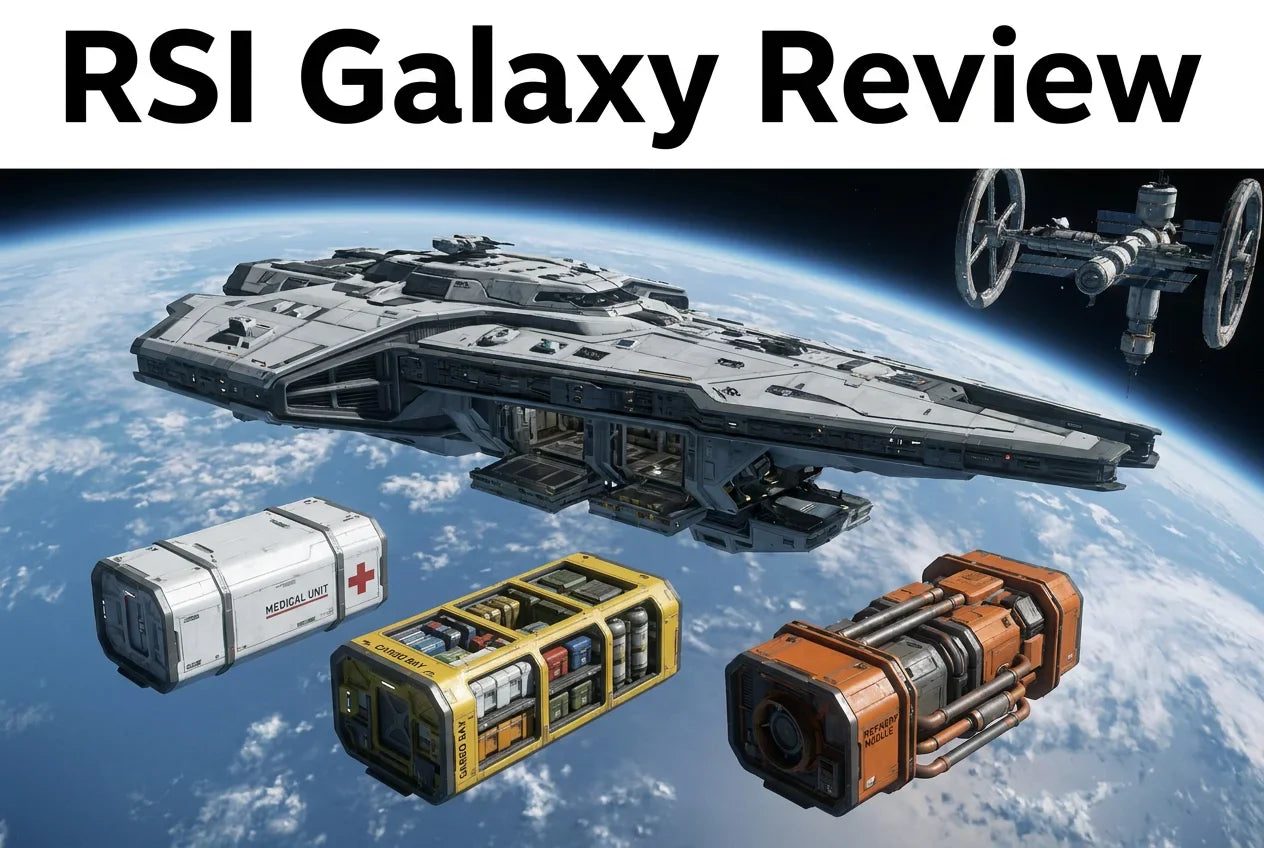
1. Introduction: The Ship That Dominated IAE 2025 Is Coming Back
The RSI Galaxy is the most ambitious multi-role platform in the Star Citizen lineup. Announced at IAE 2955 and confirmed for release at IAE 2956, it combines a heavily armored hull, modular bay system, and capital-class sensor array into a single airframe that can be a hospital, a refinery, a cargo hauler, or a mobile base depending on the module installed. At a $380 concept price, it is also one of the best value propositions in the capital-adjacent class.
This guide covers everything confirmed about the Galaxy: its three confirmed modules, its combat capability, its place in the fleet meta, how to get it with LTI, and whether it is worth its price tag relative to competing platforms like the Carrack, Liberator, and Merchantman.
2. Specifications and Design
2.1 Core Hull
| Spec | Value |
|---|---|
| Manufacturer | Roberts Space Industries (RSI) |
| Size Class | Large (Sub-Capital) |
| Concept Price | $380 |
| Estimated Flyable Price | $450-$500 |
| Crew | 1 Pilot + Optional Crew |
| Cargo (Base) | 512 SCU |
| Shields | 2x S3 (est.) |
| Weapons | Twin S5 pilot-controlled + turrets |
| Hangar | XS (Pisces/Arrow size) |
| Modules | Swappable (Medical, Cargo, Refinery) |
The Galaxy's defining feature is its belly-mounted modular bay—a cavernous space beneath the main hull that can be swapped between three distinct modules. Unlike the Carrack's fixed modular bays (which are internal and non-swappable), the Galaxy's module system allows owners to reconfigure the ship for different roles without buying additional hulls. One Galaxy hull plus two modules costs less than two specialized ships of comparable capability.
2.2 Medical Module
The Medical Module transforms the Galaxy into a mobile hospital capable of Respawn Tier 2 medical services—one tier below the Carrack's Tier 1 medbed but above the Cutlass Red's Tier 3. Key capabilities:
- Multiple medbeds with Tier 2 respawn functionality
- Medical supply storage for sustained field operations
- Dedicated triage area separate from the main habitation deck
- Direct bay-to-bay patient transfer via the main elevator system
For orgs running ground operations, the medical module makes the Galaxy the ideal forward operating base. A Galaxy with the medical module landed near a bunker or distribution center can respawn fallen teammates in seconds rather than minutes, dramatically improving ground operation tempo compared to relying on station respawns.
2.3 Cargo Module
The Cargo Module adds 512 SCU of cargo capacity on top of the Galaxy's base internal storage, bringing total cargo capacity to approximately 1,024 SCU. This puts the Galaxy in the same cargo class as the C2 Hercules (696 SCU) but with significantly more armor, better defensive weapons, and the ability to carry a support snub in the hangar. Key capabilities:
- 512 SCU additional cargo (1,024 total)
- Modular: can be swapped for Medical or Refinery as needed
- Accessible from both the main elevator and external cargo ramp
For traders, the Galaxy with the cargo module offers C2-competitive cargo volume with substantially better survivability. The trade-off is cost—a Galaxy with the cargo module costs more than a C2 and requires a larger crew to man its turrets effectively.
2.4 Refinery Module
The Refinery Module is the Galaxy's most unique capability. It allows the Galaxy to refine raw ore on-site, eliminating the need to transport unrefined quantanium or other volatile ores to a station refinery. Key capabilities:
- Onboard ore refining with comparable efficiency to station refineries
- Eliminates quantanium timer risk—refine before the ore destabilizes
- Enables deep-space mining operations far from station infrastructure
- Can refine for multiple Prospectors or MOLEs simultaneously
For industrial orgs, the Galaxy with the refinery module is a force multiplier. A single Galaxy supporting three MOLEs can refine all three ships' output on-site, eliminating the 15-20 minute transit time to a station refinery per run. Over a four-hour mining session, this saves multiple hours of transit time and eliminates the risk of losing quantanium loads to the destabilization timer.
3. Combat Capability
The Galaxy is not a warship, but it is far from defenseless. Twin S5 pilot-controlled weapons give it firepower comparable to the Constellation series, and multiple turret positions provide 360-degree coverage against fighters:
| Weapon Position | Size | Coverage |
|---|---|---|
| Pilot (2x S5) | Forward | Frontal arc |
| Dorsal Turret | 2x S3 (est.) | Upper hemisphere |
| Ventral Turret | 2x S3 (est.) | Lower hemisphere |
| Rear Turret | 2x S2 (est.) | Aft coverage |
With a full crew, the Galaxy can engage multiple fighters simultaneously while the pilot focuses on the primary threat. The S5 pilot weapons can pressure even medium fighters, and the turret network deters light fighters that would normally circle-strafe a defenseless cargo ship. Against a group of 2-3 pirates in Cutlass Blacks or Buccaneers, a fully crewed Galaxy has a realistic chance of winning the fight or buying enough time to quantum jump to safety.
4. Comparison: Galaxy vs. Competitors
| Feature | RSI Galaxy | Anvil Carrack | Anvil Liberator | Banu Merchantman |
|---|---|---|---|---|
| Price | $380 (concept) | $600 | $575 | $650 |
| Pilot Weapons | 2x S5 | None | None | Unknown |
| Cargo | 512 (1,024 w/ module) | 456 | 0 (vehicle transport only) | ~3,500 (concept) |
| Modular | Yes (3 modules) | Fixed bays | Vehicle platform | Shops + cargo |
| Hangar | XS (Pisces/Arrow) | XS (Pisces) | XS + XS + XXS pads | Unknown |
| Medbed | Tier 2 (w/ module) | Tier 1 | None | Unknown |
| Best Role | Multi-role fleet support | Exploration | Vehicle carrier | Trading hub |
The Galaxy's competitive advantage is price-to-capability ratio. At $380, it costs less than the Carrack, Liberator, or Merchantman while offering pilot weapons that none of the competitors provide and a modular system that allows one hull to fill multiple fleet roles. The Carrack offers Tier 1 medical and better exploration sensors. The Liberator carries more vehicles. The Merchantman carries vastly more cargo. But none of them can be a hospital on Tuesday, a refinery on Wednesday, and a cargo hauler on Thursday with a module swap.
5. Is the Galaxy Worth It?
5.1 The Investment Case
The Galaxy is expected to reach flyable status at IAE 2956 (November 2026). Concept-to-flyable appreciation is estimated at $70-$120 ($380 → $450-$500), following the pattern established by the Perseus ($675 concept) and Polaris ($750 concept). For investors, the Galaxy represents a medium-risk, medium-reward play with a relatively short holding period of approximately six months.
5.2 The Practical Case
For active players, the Galaxy's value depends entirely on how many modules you buy. The base hull at $380 is competitive with the C2 ($400) for cargo and the Carrack ($600) for multi-role operations. Adding one module pushes total cost to $430-$480. Adding all three pushes it to $530-$620—still less than a Carrack, with more flexibility.
5.3 The LTI Opportunity
Galaxy original concept sales carry LTI. If you missed the IAE 2955 concept sale, the Galaxy will return at IAE 2956 with its flyable release, likely at the increased $450-$500 price point without LTI. The secondary market still has Galaxy LTI concept pledges available at or near the $380 concept price. Acquiring one now, before the IAE 2956 price increase, captures the full concept-to-flyable appreciation.
6. Best Use Cases
- Org Logistics Hub. A Galaxy with the cargo module carries 1,024 SCU—enough to supply a full org mining or combat operation. The hangar carries a Pisces for scouting. The pilot weapons deter casual pirates. No other sub-capital ship combines this much cargo, this much defense, and this much utility at this price.
- Mobile Medical Base. Galaxy with the medical module provides Tier 2 respawn in the field. For orgs running FPS operations or ground vehicle combat, having a respawn point 30 seconds from the fight instead of 5 minutes away at a station is the difference between winning and losing objective-based engagements.
- Deep-Space Mining Support. Galaxy with the refinery module supporting a MOLE mining wing eliminates all transit time to station refineries. The quantanium timer becomes irrelevant. The mining wing stays on-site for hours, refining as they go, and only returns to sell when holds are full.
- Investment Vehicle. Buy at $380 concept now, sell at $450-$500 after flyable release in November 2026. Six-month holding period for $70-$120 appreciation. If you buy multiple concept tokens during IAE 2025 and hold them, the return is comparable to any ship investment in the game.
7. Conclusion: The Best Value in Its Class
The RSI Galaxy is the best sub-capital value proposition in Star Citizen. At $380, it undercuts every comparable multi-role platform by $200-$270 while offering capabilities—modular role switching, pilot S5 weapons, and capital-class armor—that no competitor matches at any price. The confirmed flyable release at IAE 2956 means the concept-to-flyable appreciation window is closing within six months.
If you operate an org, trade seriously, mine in groups, or simply want the most flexible large ship in the game for the lowest possible price, the Galaxy is worth your pledge.
Browse fleet ships at ORONST ORBITAL →
Disclaimer: Galaxy specifications are based on concept materials and Q&A communications. Final flyable specifications may differ. IAE 2956 release date is confirmed by CIG. ORONST ORBITAL is an independent marketplace.


