


1. Introduction: The Cargo Ship Question No One Agrees On
Ask five veteran Star Citizen traders which cargo ship is best, and you will get five different answers. The C2 Hercules carries the most cargo. The Caterpillar is the most modular. The Gatac Railen is the wildcard that no one has flown yet. Each ship represents a fundamentally different philosophy about what a cargo ship should be, and choosing wrong means either dying to pirates with a hold full of valuable commodities or spending millions of aUEC on a ship that earns slower than a smaller, cheaper alternative.
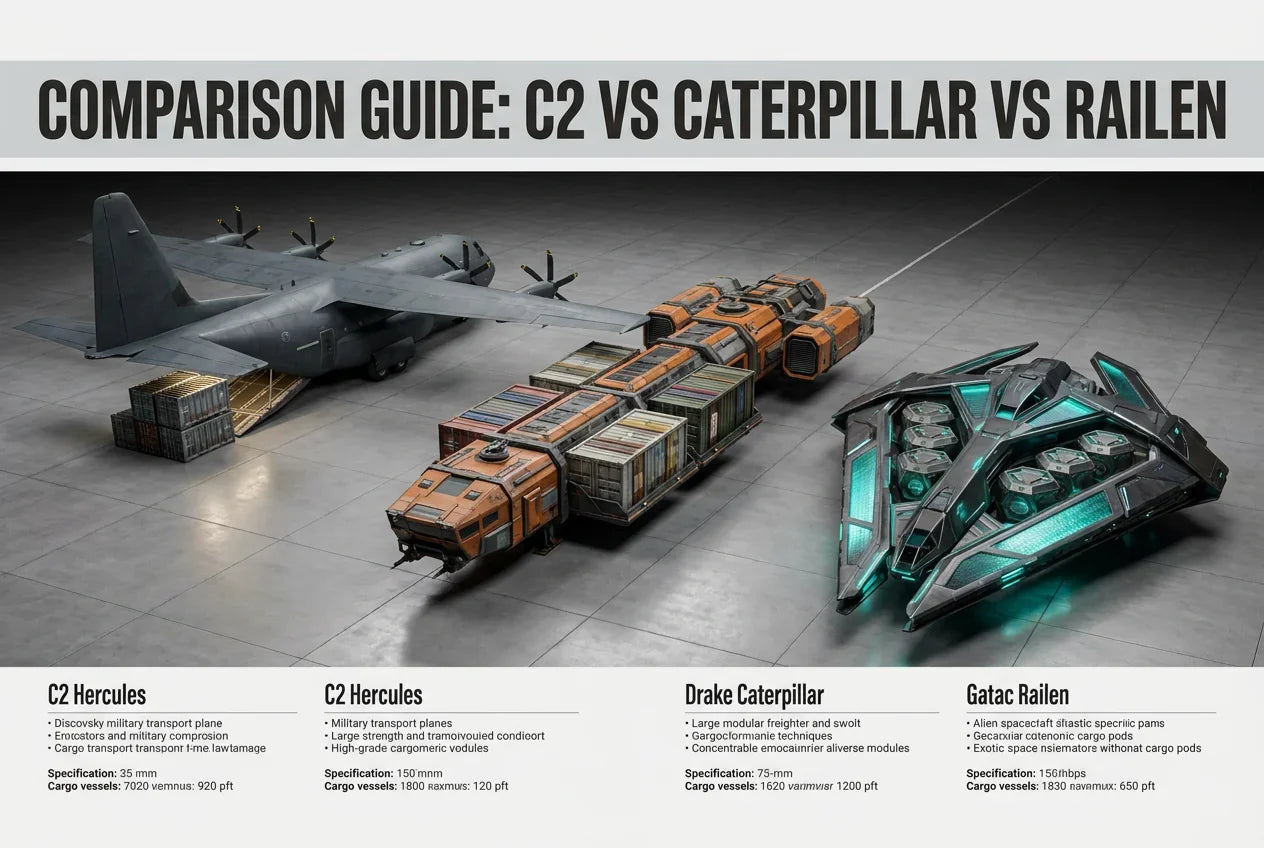
This head-to-head comparison evaluates the C2 Hercules Starlifter ($400), Drake Caterpillar ($330), and Gatac Railen ($225 concept) across six dimensions: cargo capacity, survivability, operational flexibility, value per dollar, upgrade path, and real-world trade route profitability. By the end, you will know which ship fits your trading style and budget.
2. Raw Specifications
| Spec | C2 Hercules | Caterpillar | Gatac Railen |
|---|---|---|---|
| Store Price | $400 | $330 | $225 (concept) |
| aUEC Price | ~4,925,500 | ~4,686,600 | Not flyable |
| Cargo Capacity | 696 SCU | 576 SCU | ~320 SCU (triangular pods) |
| Shields | 2x S3 | 2x S3 | 2x S2 (est.) |
| Pilot Weapons | None | 4x S3 (gimbaled) | Unknown |
| Turrets | 3x Remote (2x S4 each) | 2x Manned (2x S3 each) | Unknown |
| Crew | 1-2 | 1-4 | 1-2 |
| Vehicle Transport | Yes (full bay) | Yes (front bay) | No |
| Command Module | No | Yes (detachable) | No (Xi'an cockpit pod) |
| Quantum Range | ~90 GM | ~70 GM | ~120 GM (est., Xi'an drive) |
3. Cargo Capacity and Route Efficiency
3.1 The C2 Advantage: Raw Volume
The C2's 696 SCU cargo bay is the largest in the game among flyable ships. On high-volume, low-margin commodities like Agricium or Titanium, the C2's volume advantage is decisive. A single C2 run from Bezdek to Area18 carrying 696 SCU of Titanium at a 2,500 aUEC per SCU margin nets 1,740,000 aUEC per trip. A Caterpillar carrying 576 SCU on the same route nets 1,440,000 aUEC. Over ten runs, the C2 earns 3 million more aUEC.
However, the C2 cannot land at outpost pads—it requires large hangars. This restricts it to station-to-station or station-to-landing-zone routes that are often longer and more exposed to interdiction. The Caterpillar, while carrying less, can access outposts that the C2 cannot, shortening route distances and enabling commodity pickups at locations with less competition.
3.2 The Caterpillar's Hidden Efficiency
The Caterpillar's modular cargo bays—four detachable modules plus a front vehicle bay—provide an operational flexibility that raw SCU numbers do not capture. A Caterpillar can carry 576 SCU of bulk cargo OR split into mixed loads (commodities in bays 1-2, a ground vehicle in the front bay, and an escort snub in bay 4). The C2 must commit its entire bay to a single purpose. On mixed routes where bulk commodities account for only 60% of the run and the remaining space carries smaller high-value items, the Caterpillar's flexibility narrows the total profit gap to nearly zero.
3.3 The Railen's Unknown Variable
The Gatac Railen carries approximately 320 SCU in triangular external cargo pods—an alien design philosophy that prioritizes speed and agility over raw capacity. If the Railen's Xi'an grav-lev drive enables atmospheric speeds that significantly outpace the C2 and Caterpillar, its lower SCU count may be offset by faster round-trip times. A Railen completing three runs in the time a C2 completes two effectively delivers 960 SCU to the C2's 1,392 SCU over the same period at a much lower fuel cost and investment. Until flyable, the Railen's true profitability remains theoretical—but the theory is compelling.
4. Survivability
4.1 Shields and Armor
All three ships carry two shield generators, but shield size matters. The C2 and Caterpillar both mount S3 shields, the largest available to non-capital ships. The Railen's shield size is unconfirmed but expected to be S2 based on its size class and Xi'an component sizing conventions. Against a crewed pirate Mantis or Cutlass Black, the S3 shield difference is often the margin between escaping and exploding.
4.2 Escape Mechanics
The Caterpillar's command module is the only true escape system in the comparison. If the cargo section is disabled, the command module detaches and flies away as an independent ship. The C2 has no escape system—if it goes down, the crew goes with it. The Railen's Xi'an cockpit pod may offer some form of ejection or separation, but details are unconfirmed. For traders running routes through Pyro or other lawless systems, the Caterpillar's command module is worth the cargo capacity trade-off.
4.3 Defensive Armament
The Caterpillar carries four S3 gimbaled pilot weapons—the only ship in this comparison where the pilot can fight back. The C2 relies entirely on turret gunners for defense, making solo C2 operation extremely risky in contested space. The Railen's weapon loadout is unannounced, but Xi'an ships typically emphasize speed and maneuverability over raw firepower. For solo traders, the Caterpillar's pilot weapons are the decisive survivability factor.
5. Operational Flexibility
| Capability | C2 Hercules | Caterpillar | Gatac Railen |
|---|---|---|---|
| Vehicle Transport | Excellent (full bay, any vehicle) | Good (front bay, up to Ursa size) | None |
| Ship Transport | Yes (small fighters/snubs) | No | No |
| Outpost Landing | Limited (large hangar only) | Yes (medium pad) | Unknown (medium expected) |
| Solo Operation | Poor (no pilot weapons) | Excellent (4x S3 pilot guns) | Unknown |
| Multi-Role | Good (cargo, transport, medical with module) | Excellent (cargo, modular bays, salvage future) | Limited (pure cargo) |
The C2 is the only ship in this comparison that can transport other ships and ground vehicles simultaneously, making it indispensable for org logistics and fleet operations. The Caterpillar's modular bays will eventually support non-cargo modules (salvage, medical, repair) that could transform it into a multi-role platform. The Railen is a pure cargo ship with no confirmed non-cargo capabilities.
6. Value Per Dollar
6.1 The Railen's Concept Advantage
At $225, the Railen is the cheapest ship in this comparison by a wide margin. Even accounting for its lower cargo capacity, the dollar-to-SCU ratio tells a clear story:
| Ship | Store Price | Cargo (SCU) | SCU per Dollar | Concept-to-Flyable Appreciation |
|---|---|---|---|---|
| Gatac Railen | $225 | ~320 | 1.42 SCU/$ | +$50-75 (estimated) |
| Caterpillar | $330 | 576 | 1.75 SCU/$ | Already flyable |
| C2 Hercules | $400 | 696 | 1.74 SCU/$ | Already flyable |
The Caterpillar surprisingly offers the best SCU per dollar among flyable ships. The C2 costs $70 more for only 120 additional SCU, making the incremental cost per SCU a poor $0.58/SCU. The Railen's dollar-per-SCU is lower than both, but the expected $50-$75 appreciation from concept to flyable more than compensates.
6.2 CCU Chain Potential
All three ships can be reached via CCU chains. The Railen, at $225, is the easiest to reach with a short chain and represents the best CCU target for budget-conscious builders. The Caterpillar at $330 requires a longer chain but benefits from Drake's aggressive event pricing. The C2 at $400 requires the longest chain but offers the highest absolute savings when built via multi-event warbond stacking.
7. Trade Route Profitability (Real Numbers)
7.1 High-Volume Route: Bezdek → Area18 (Titanium)
| Ship | SCU | Margin/SCU | Profit/Run | Runs/Hour | Profit/Hour |
|---|---|---|---|---|---|
| C2 Hercules | 696 | ~2,500 aUEC | 1,740,000 | 2 | 3,480,000 |
| Caterpillar | 576 | ~2,500 aUEC | 1,440,000 | 2.5 | 3,600,000 |
| Railen (est.) | 320 | ~2,500 aUEC | 800,000 | 3-4 (faster) | 2,400,000 - 3,200,000 |
On outpost-accessible routes, the Caterpillar's ability to land where the C2 cannot gives it a runs-per-hour advantage that offsets its lower SCU count. The Caterpillar actually out-earns the C2 per hour on this route class. The Railen's theoretical faster speed could bring it close to the Caterpillar's hourly rate despite carrying nearly half the cargo.
7.2 Station-to-Station Route: CRU-L1 → Area18 (Medical Supplies)
| Ship | SCU | Margin/SCU | Profit/Run | Runs/Hour | Profit/Hour |
|---|---|---|---|---|---|
| C2 Hercules | 696 | ~1,800 aUEC | 1,252,800 | 3 | 3,758,400 |
| Caterpillar | 576 | ~1,800 aUEC | 1,036,800 | 3 | 3,110,400 |
On station-to-station routes where both ships can operate freely, the C2's raw volume advantage is decisive. The C2 earns 20% more per hour.
8. Which Ship Is Right for You?
- Choose the C2 Hercules if you run station-to-station bulk routes, operate with org logistics support, or need to transport vehicles and ships alongside cargo. The C2 is the professional trader's tool—unbeatable efficiency on optimized routes, but vulnerable when solo and expensive to lose.
- Choose the Caterpillar if you are a solo trader who needs to fight back, run outpost-accessible routes, or value modular flexibility. The Caterpillar is the working captain's ship—lower peak efficiency than the C2 but usable in situations where the C2 cannot operate. The command module escape system is priceless in Pyro.
- Choose the Gatac Railen if you want concept-to-flyable appreciation, the lowest dollar entry point, and a fast, agile freighter for medium-volume routes. The Railen is the smart money bet—buy at $225 now, watch it appreciate to $275-$300 at flyable, and enjoy Xi'an build quality and atmospheric speed that no human freighter matches.
In truth, a well-rounded trader's fleet includes two of the three. A C2 for bulk routes and a Railen for speed runs. Or a Caterpillar for outpost access and a Railen for long-range alien system routes when those open. If you can only afford one, start with the Caterpillar for flyable capability or the Railen for concept appreciation.
Buy the Gatac Railen at ORONST ORBITAL →
Disclaimer: Railen specifications are estimates based on concept materials and may change before the ship reaches flyable status. Trade route profit figures are based on Star Citizen 4.0.2 economy data and are subject to change with economy balancing. ORONST ORBITAL is an independent marketplace.


