


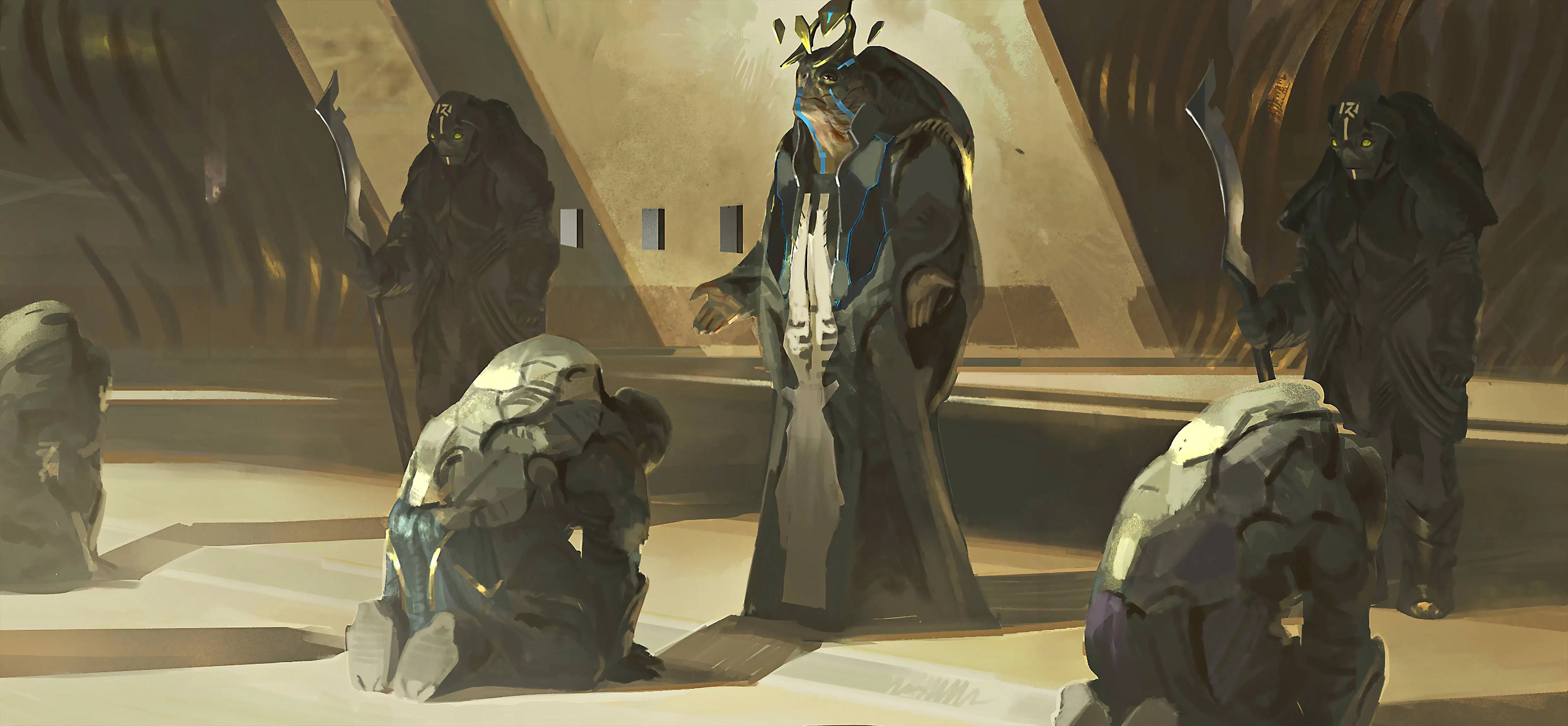
Alien Week isn't just a sale. It commemorates First Contact Day — June 12, 2438 — the moment humanity learned we weren't alone. That discovery reshaped everything: our politics, our technology, our military doctrine, and ultimately our understanding of our place in the galaxy.
The Xi'an: First Contact, First Tension
Humanity's first encounter with intelligent alien life was not peaceful. A survey ship entered Xi'an territory without knowing it. The Xi'an Empire — ancient, territorial, spacefaring while humans built pyramids — saw it as an incursion. The resulting cold war lasted centuries and defined two generations of military procurement on both sides.
The Xi'an aren't villains. They're a civilization whose technology reflects millennia of refinement. Grav-lev systems that make our thrusters look primitive. Ship orientation based on vertical space utilization rather than horizontal decks. Materials that feel organic — curved bulkheads, warm lighting, surfaces that look like worked stone. Every Xi'an ship is an artifact of a culture that solved engineering problems differently, and in many cases, solved them better.
The relationship has thawed significantly. Gatac Manufacture actively markets to Human pilots. Aopoa builds fighters that Human mercenaries prefer over Drake or Anvil equivalents. The Railen — with its dual-crew cockpit accommodating both species — is the clearest symbol of Xi'an-Human cooperation in the modern era.
The Banu: The First Friends
After the Xi'an tension, meeting the Banu was a relief. Where the Xi'an were territorial, the Banu were curious. Where the Xi'an demanded distance, the Banu wanted to trade. The Banu Souli system — semi-autonomous guilds governing their own economic spheres — meant Humanity could establish commercial relationships without navigating a single centralized government.
The Banu don't build empires. They build marketplaces. The Defender exists because Banu traders needed escorts — and Banu engineering always favors durability over everything else. The Merchantman exists because a Banu Souli saw an opportunity in the Human market and poured centuries of trading expertise into a ship designed to serve as both transport and destination.
Humanity's relationship with the Banu has been almost entirely peaceful. Almost entirely commercial. And almost entirely built on mutual respect for a good deal.
The Tevarin: A Cautionary Tale
The Tevarin story is more complicated. Two wars. The first ended in Tevarin surrender and absorption into the UEE. The second, decades later, was a rebellion led by Corath'Thal — a charismatic warlord who nearly succeeded in reclaiming Tevarin independence. Humanity won both conflicts, but the cost in lives and cultural erasure was staggering.
Esperia's Tevarin replicas — the Prowler, the Talon — are built from designs captured during those wars. Flying a Prowler means flying a ship designed to breach Human vessels. Flying a Talon means flying a fighter built by a civilization we defeated. That tension makes Tevarin ships some of the most narratively rich choices in the game.
The Vanduul: The Ongoing Threat
The Vanduul are the reason Esperia builds combat replicas at all. The Vanduul War is ongoing — not a cold war, not a historical footnote, but an active conflict costing Human lives every day. The Blade and Glaive exist because understanding enemy ship design is a military necessity. They were reverse-engineered from wrecks pulled off battlefields.
There is no trade relationship with the Vanduul. No diplomacy. No cultural exchange. Just salvage and study. When you climb into a Blade, you're climbing into a machine built by an enemy that would kill you without hesitation — and that knowledge changes how the cockpit feels.
Why Ships Carry Stories
Alien Week is easy to reduce to discounted prices. But every ship in the alien catalog carries a story. The Railen represents cooperation after centuries of cold war. The Defender represents Banu pragmatism — a fighting ship built by a trading culture. The Prowler represents Tevarin craftsmanship from a civilization that lost two wars and was absorbed into the empire that defeated them. The Blade represents a threat humanity is still fighting.
When you buy an alien ship during Alien Week, you're not just getting a Warbond discount. You're buying a piece of that history — a machine designed by minds that think differently, built by hands from worlds we once feared, now flying under Human command. First Contact Day happened 518 years ago. The consequences are still unfolding. And every alien ship in your hangar is a chapter in that story.


