


INTRODUCTION: THE ARCHITECTURAL SHIFT OF ALPHA 4.0
Star Citizen Alpha 4.0 marks the most significant architectural shift in the history of distributed computing within the gaming industry. For over a decade, Cloud Imperium Games (CIG) has been developing the foundations for a universe that is truly persistent, massive, and seamless. The cornerstone of this vision is Server Meshing. In this technical whitepaper, we will dissect the mechanics of Static and Dynamic Server Meshing, the implementation of the Pyro system, and how these changes will fundamentally redefine the pilot experience in 2026.
CHAPTER 1: THE SERVER MESHING HOLY GRAIL
Until now, every Star Citizen player was confined to a single server instance capable of handling roughly 100 players and the entirety of the Stanton system. This led to "Server FPS" degradation, where the simulation would slow down as the server struggled to calculate the physics and AI of thousands of entities. Server Meshing solves this by breaking the world into discrete authority zones.
1.1 STATIC SERVER MESHING (THE 4.0 STANDARD)
In Alpha 4.0, CIG implements Static Server Meshing. In this model, the Stanton system and the Pyro system are hosted on separate server nodes. As a player moves through a Jump Point, their "authority" is handed off from one server to another seamlessly. This effectively doubles the available computing power for the game world, allowing for higher player counts and smoother AI responsiveness.
1.2 THE REPLICATION LAYER
The unsung hero of this transition is the Replication Layer. By decoupling the game state from the simulation server, CIG has created a buffer that allows servers to crash and restart without disconnecting the players. If a server node in Pyro fails, the Replication Layer holds the data of your ship, location, and inventory while a new server spins up to take over the simulation. This is the foundation of 24/7 uptime in the Persistent Universe.
CHAPTER 2: DESTINATION PYRO — SURVIVAL IN THE RADIANCE
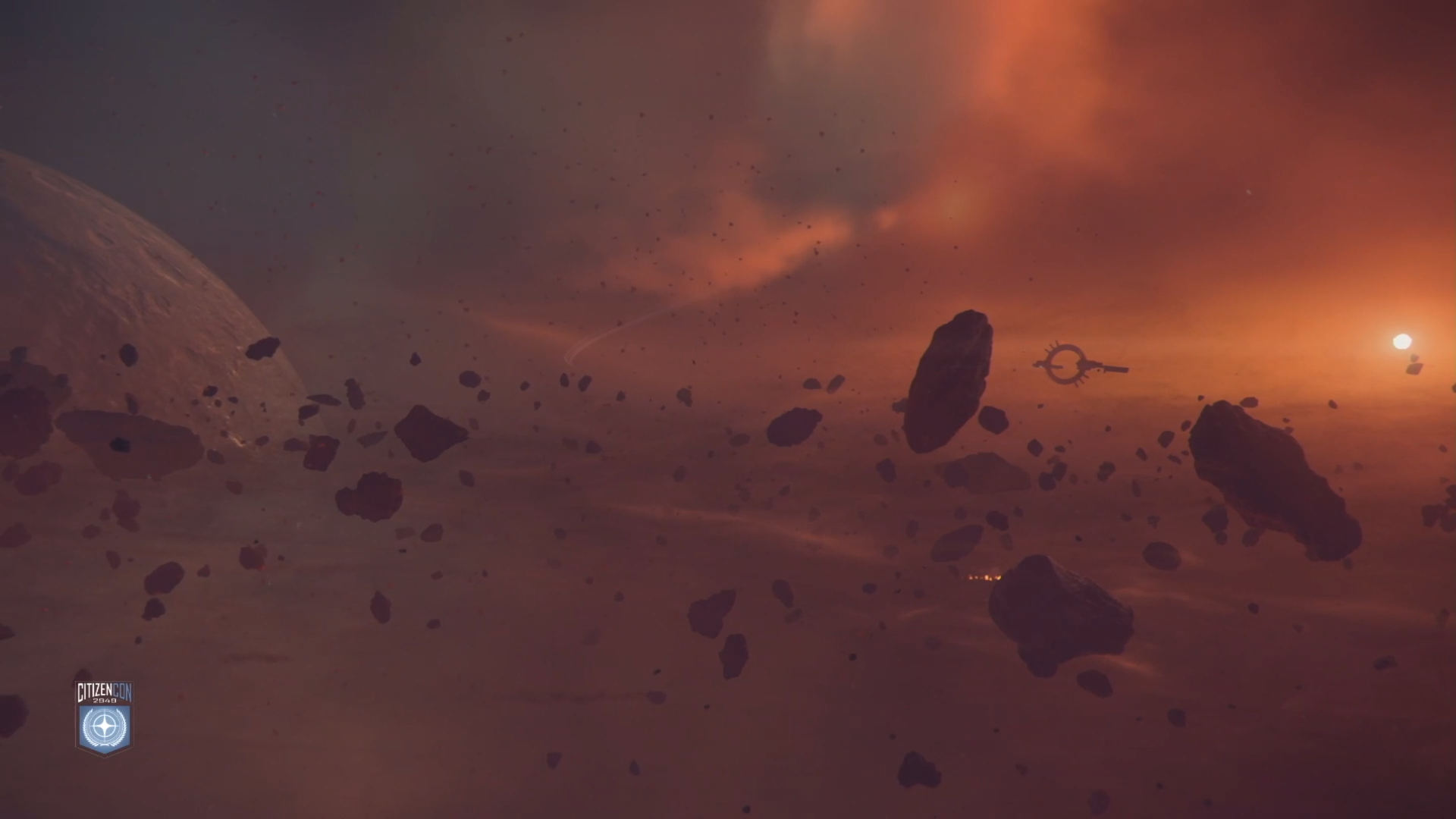
Pyro is not Stanton. Where Stanton is a civilized corporate sandbox, Pyro is a chaotic, resource-scarce frontier. The system revolves around Pyro I, a flare star that periodically emits massive bursts of radiation that can disable ships and kill unprotected players.
| PLANET / MOON | HAZARD LEVEL | PRIMARY RESOURCE | OPERATIONAL NOTE |
|---|---|---|---|
| Pyro I (Monolith) | EXTREME | Quantainium | Extreme heat; specialized cooling required. |
| Pyro VI (Bloom) | MODERATE | Hydrogen / Fuel | Orbiting Checkpoint; High Pirate Activity. |
CHAPTER 3: JUMP POINT NAVIGATION AND LOGISTICS
The Jump Point is the physical manifestation of Server Meshing. It is a tunnel through space-time where the handoff between Stanton and Pyro occurs. For pilots, this is a manual flight challenge. Larger ships like the Anvil Carrack or the RSI Galaxy are equipped with Size 3 Jump Drives, allowing them to stabilize the tunnel for a smoother transition. Small starters will find the turbulence of a Jump Point far more taxing on their components.
CONCLUSION: PREPARING FOR THE WIPE
With 4.0 comes the "Great Wipe." CIG has confirmed a full reset of aUEC and reputation to ensure the new economy functions under the multi-system model. Savvy players are already looking at their web hangars to ensure their fleets are LTI-ready and CCU-optimized. ORONST ORBITAL is committed to providing the most up-to-date intelligence as we move into this new era of galactic exploration.


